Explore the Western Esoteric Tradition as a Living Map
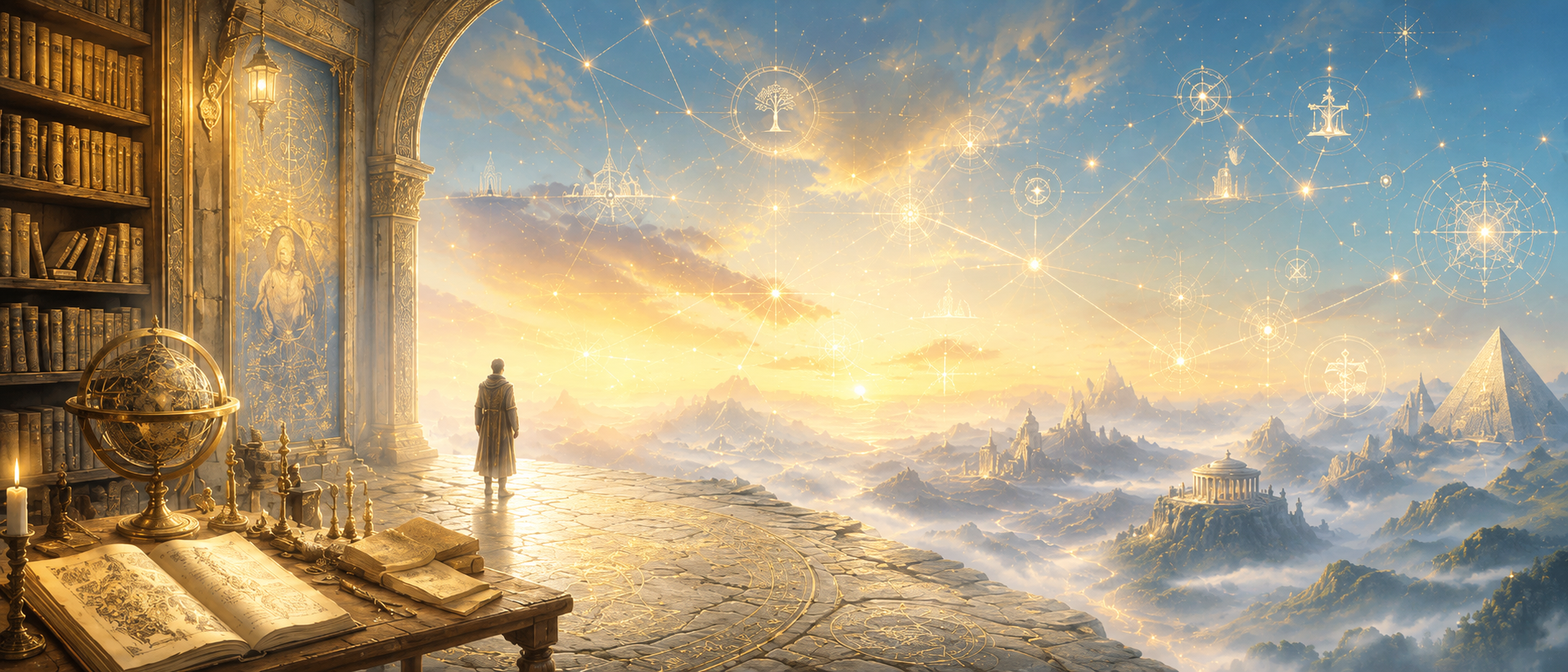
The Western Esoteric Tradition is not a straight line.
It is a field of recurring ideas, revived texts, symbolic borrowings, disputed lineages, and unexpected convergences. Hermeticism, Kabbalah, alchemy, Rosicrucianism, Freemasonry, Theosophy, ritual magic, and modern esotericism do not sit in sealed compartments. They speak to one another across centuries.
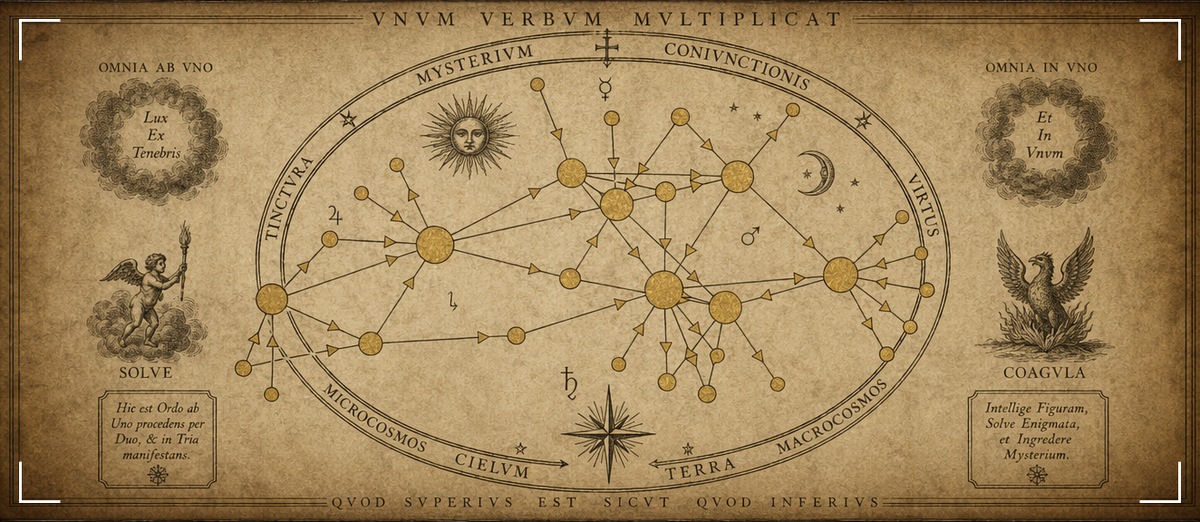
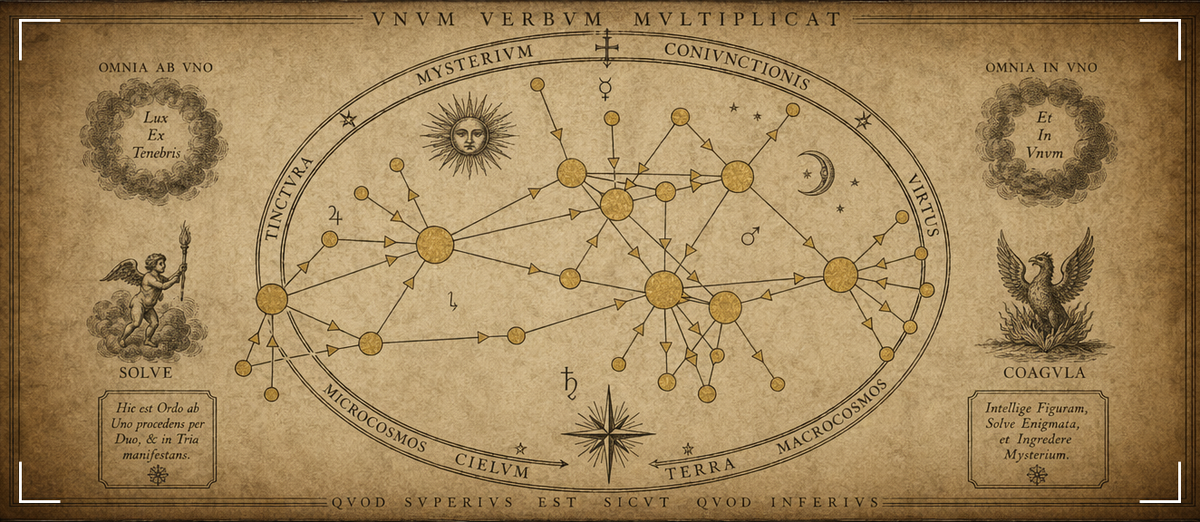
That is why Sub Umbra has developed the Western Esoteric Tradition Nodal Map: an interactive visual guide designed to help users see these relationships at a glance.
Rather than presenting esotericism as a list of isolated topics, the map treats it as a network. Each major current appears as a node. The lines between nodes indicate relationships of influence, inheritance, transmission, or conceptual affinity. The result is not a rigid genealogy, but a structured way of exploring a complex tradition.
A Map, Not a Timeline
Timelines are useful, but the Western Esoteric Tradition does not always behave politely in chronological order.
Late antique Hermetic texts resurface in Renaissance Florence. Medieval Kabbalah is reimagined by Christian scholars. Rosicrucian symbolism finds new life in later occult orders. Masonic, Theosophical, magical, and esoteric Christian currents intersect in ways that are historical, symbolic, textual, and sometimes retrospective.
The Nodal Map allows users to see these overlapping relationships in a way that prose alone often struggles to convey.
You might begin with Late Antique Hermeticism & Gnosticism, move into Renaissance Christian Kabbalah & Hermetic Magic, continue toward Rosicrucianism, and then follow later developments into the Hermetic Order of the Golden Dawn, Thelema, or Modern Qabalah.
The point is not to flatten history into a single chain of influence. It is to see how ideas travel, change, reappear, and acquire new meanings.
What the Map Allows You to Do
The map has been designed as both a navigational tool and an interpretive aid.
You can click on a tradition to bring it into focus and read a concise overview. Each selected node may include its historical era, associated figures, primary sources, antecedent traditions, and succeeding traditions.
The Explore panel lets you inspect a tradition and its immediate intellectual neighbourhood.
The Reader Panel allows you to preview linked pages without losing your place in the map. This turns the map into a browsing instrument, letting you move between traditions, figures, texts, and contexts while keeping the larger structure in view.
The Trace function lets you find a route between two traditions. You can follow directed historical influence, or use a looser conceptual path to examine structural proximity. A route from Hellenistic Philosophy to Thelema, for example, is not a proof of simple descent. It is an invitation to study the intervening traditions.
Seeing Hubs, Bridges, and Patterns
One of the map’s strengths is that it reveals the shape of the field.
Some nodes are more heavily connected than others. This does not mean they are “more important” in some grand metaphysical league table, mercifully. It means that, within this interpretive model, they act as hubs.
Traditions such as Renaissance Christian Kabbalah & Hermetic Magic, Rosicrucianism, Speculative Freemasonry, Occult Revival & Ritual Magic, the Theosophical Society, and the Hermetic Order of the Golden Dawn gather older materials, reinterpret them, and pass them into later forms.
The map also helps reveal bridges between traditions that may otherwise seem distant. These points of convergence are often the most interesting places to linger.
From Curiosity to Study
The map is especially useful if you arrive through a single point of interest.
If you are interested in Freemasonry, you can begin with Operative Masonic Guilds, move into Speculative Freemasonry, examine High-Degree Masonry, and then observe wider connections with Rosicrucianism, Christian theosophy, and ritual magic.
If Hermeticism is your starting point, you can follow late antique Hermetic currents into the Renaissance revival, then onward into later occult movements.
If modern esotericism interests you, the map helps situate the Theosophical Society, Anthroposophy, the New Age Movement, Thelema, Modern Qabalah, and Neo-Paganism/Wicca within a broader field of nineteenth- and twentieth-century reinterpretation.
In each case, the map provides orientation. It does not replace close reading or careful scholarship. It gives the reader a place to begin.
A Guide, Not a Final Authority
The map should be read critically.
Influence in esoteric history is rarely simple. A later tradition may draw directly on an earlier text, but it may also inherit a symbol indirectly, revive a forgotten source, or imagine a lineage more than document one.
The map is therefore not a final authority. It is a structured aid to exploration. It selects major currents, figures, and sources important to the Sub Umbra interpretive framework. Absence from the map does not imply insignificance. Inclusion does not imply endorsement.
At its best, the map invites better questions.
How did this idea travel?
Which traditions converged here?
What was revived, transformed, or misunderstood?
Where do symbols persist after their original context has faded?
Begin Anywhere
There is no single correct way to use the Nodal Map.
Begin with a tradition you already know. Search for one you have heard mentioned. Click a node at random. Trace a route between two traditions. Or simply look at the network as a whole and observe where the field thickens, branches, and converges.
The Western Esoteric Tradition rewards slow study, but it also rewards orientation. The map offers that orientation in visual form.
It is a way into the labyrinth.
And, unlike most labyrinths, it has buttons.
Explore the Western Esoteric Tradition Nodal Map here:
https://subumbra-interactive.netlify.app/?ref=subumbra.net
Full instructions and training materials here:
 David Taylor