Emanuel Swedenborg
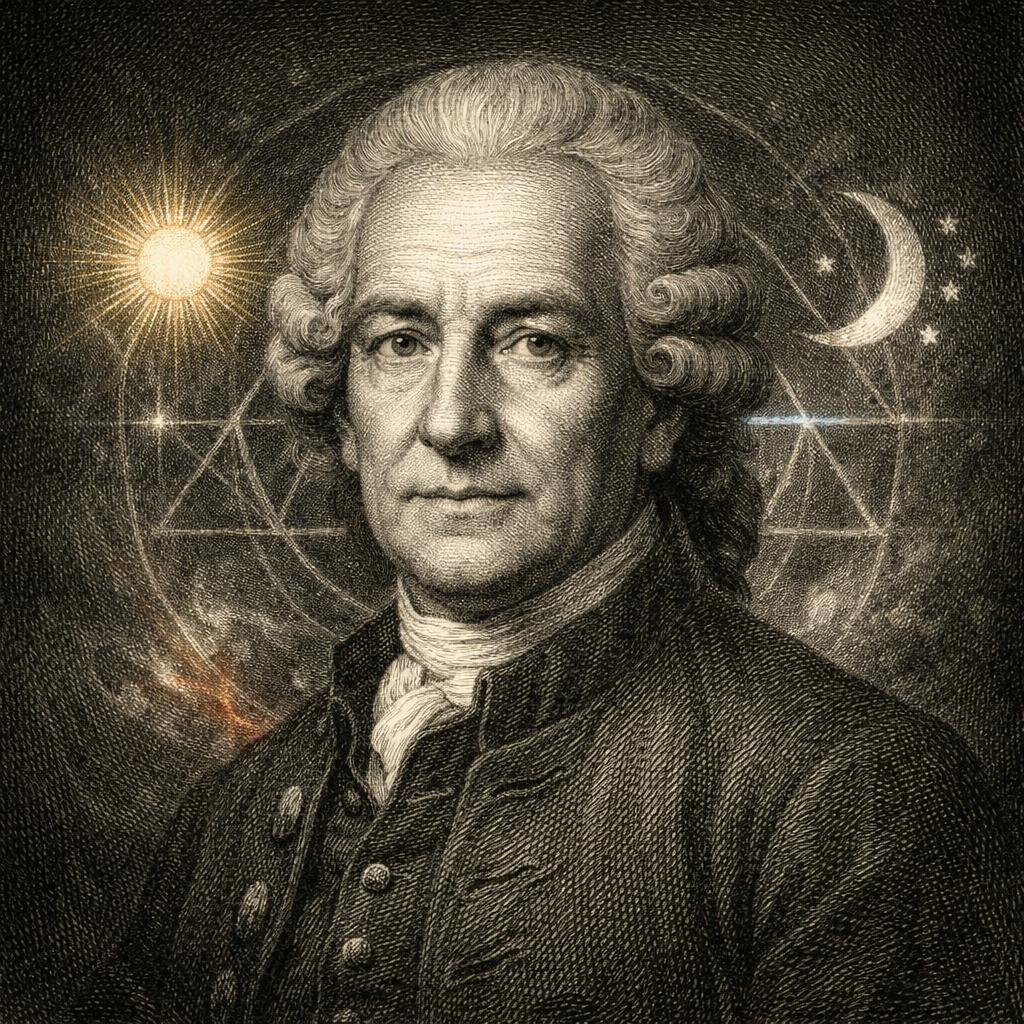
Date range: 1688–1772
Brief Biography
Emanuel Swedenborg was a Swedish scientist, engineer, philosopher, biblical interpreter, visionary, and religious writer whose work became one of the most influential sources for modern Christian esotericism. Born in Stockholm in 1688, he first established himself as a polymath of the Swedish Enlightenment, writing on mining, mechanics, anatomy, cosmology, and natural philosophy. In midlife he underwent a profound spiritual crisis and began to record visionary experiences that he understood as direct access to the spiritual world. His later writings describe heaven, hell, angels, spirits, the inner meaning of scripture, divine influx, and the correspondence between material and spiritual realities. Swedenborg died in London in 1772, leaving a vast body of work that shaped Romanticism, occult revivalism, Theosophy, and later esoteric interpretations of Christianity.
Works and Texts
- Aurora
- Heaven and Hell
- Treatise on the Reintegration of Beings
- Tableau Naturel
Place in the Western Esoteric Tradition
Swedenborg occupies a major place in the Western Esoteric Tradition because he gave Christian visionary experience an unusually detailed metaphysical and symbolic structure. His doctrine of correspondences, his descriptions of the spiritual world, and his account of the relation between visible and invisible realities made him a central source for later esoteric religion. He stands at the intersection of Lutheran mysticism, Pietism, speculative religion, Rosicrucian and Masonic atmospheres, and eighteenth-century visionary Christianity. His influence extended into Romanticism, occult revivalism, and the Theosophical Society, where his accounts of higher worlds, spiritual bodies, angelic states, and inner meanings became part of a much larger modern esoteric vocabulary. Swedenborg made the unseen world sound less like a rumour and more like a geography, which is both his power and his problem.
Swedenborg’s Mystical System
Emanuel Swedenborg’s mystical system is organised around the relation between the natural and spiritual worlds. The visible world is not isolated from the invisible. It is the outer expression of a deeper spiritual order. Everything in nature corresponds to something in the spiritual realm, and every material form may be read as the outward sign of an inward reality. This doctrine of correspondences is the key to Swedenborg’s thought. It allows scripture, nature, the human body, social life, heaven, and hell to be interpreted as related levels of a single divine order.
Swedenborg’s early scientific and philosophical work prepared the ground for his later visionary system. He was trained to think in terms of structure, function, hierarchy, and relation. His studies of anatomy, cosmology, and natural processes encouraged a view of the universe as ordered and interconnected. When his attention turned decisively to spiritual realities, he did not abandon the habit of systematic description. He applied it to the invisible world. The result is a visionary theology with the texture of an atlas.
The doctrine of correspondence gives Swedenborg’s system its distinctive coherence. Physical things are not arbitrary symbols assigned meanings by human imagination. They are expressions of spiritual realities according to divine order. Light corresponds to truth, warmth to love, the heart to will, the lungs to understanding, marriage to the union of love and wisdom. Such correspondences operate in scripture as well as in nature. Biblical narratives therefore contain an inner sense beneath the literal text. The letter of scripture is the body; the spiritual meaning is the soul.
This approach places interpretation at the centre of spiritual life. To read scripture properly is to perceive the spiritual realities concealed within its literal form. Swedenborg’s exegesis is neither simple allegory nor historical criticism in the modern sense. It is a symbolic theology grounded in the conviction that divine revelation descends through levels. Each level clothes a higher truth in forms suited to the minds that receive it. The task of the interpreter is to rise from the outer form toward the inward meaning.
Swedenborg’s descriptions of heaven and hell are among his most influential writings. In Heaven and Hell, he presents the afterlife as a structured continuation of inner life rather than a remote divine reward or punishment imposed externally. Human beings enter spiritual communities corresponding to their ruling loves. Heaven is ordered by love to the Lord and love of the neighbour. Hell is formed by self-love and the love of domination. The afterlife reveals the true quality of the self. Death strips away outward masks and places the soul within the society that matches its inner orientation.
This moral psychology gives Swedenborg’s system considerable force. Heaven and hell are not merely places. They are states of being, social orders, and spiritual environments generated by love. The human person is shaped from within by what he or she loves most deeply. Thought, action, habit, and desire gradually form the soul’s spiritual body. The afterlife makes visible what earthly life has formed invisibly. This idea would become powerful for later esoteric and Romantic writers, who found in Swedenborg a spiritual anthropology of inward states and symbolic worlds.
The spiritual world in Swedenborg is highly populated and organised. Angels and spirits live in communities, communicate through spiritual perception, and inhabit landscapes corresponding to their inner condition. These landscapes are not illusions. They are real forms in the spiritual world, produced according to correspondences. A garden, a house, a city, a mountain, or a desert manifests the state of those who dwell there. Swedenborg’s visionary world is therefore both objective and symbolic. It exists outside the individual mind, yet its forms reveal spiritual qualities directly.
Divine influx is another central principle. Life flows from God into all created beings. Human freedom depends on the reception and orientation of this influx. Evil arises when divine life is turned toward self-love and falsity; regeneration occurs when the will and understanding are reordered toward love and truth. Salvation is not an arbitrary legal transaction. It is the gradual reformation of the inner person. The spiritual life consists in allowing divine order to reshape loves, thoughts, and actions.
Swedenborg’s relation to Lutheran mysticism and Pietism is visible in his concern with inward regeneration, practical charity, and the living transformation of the heart. Religion is not primarily external ceremony or doctrinal assent. It is the reformation of life. Yet Swedenborg’s system goes far beyond conventional Pietism by mapping invisible worlds, angelic societies, cosmic correspondences, and the inner sense of scripture with extraordinary confidence. It is devotional, moral, visionary, and metaphysical at once.
His importance for later esotericism lies partly in the fact that he made Christian visionary cosmology intellectually usable for the modern age. Later readers could draw from him a doctrine of correspondences, a model of spiritual worlds, an account of subtle spiritual embodiment, and a method for reading scripture symbolically. Romantic writers were drawn to the imaginative power of his universe. Occult revivalists found in him a witness to higher planes and hidden laws. Theosophical writers absorbed and transformed his language of spiritual worlds, invisible bodies, and graded states of consciousness.
Swedenborg’s mystical system may therefore be described as a Christian science of correspondences. The natural world expresses the spiritual world; scripture contains an inner sense; the human person is formed by ruling love; heaven and hell reveal interior states; and divine life continually flows into creation. His work gave the Western Esoteric Tradition one of its most durable models of symbolic reality. The world is readable because it is ordered, and it is ordered because it proceeds from divine wisdom and love.
Antecedent Figures
- Andrew Michael Ramsay
- Elias Ashmole
- James Anderson
- Jean-Baptiste Willermoz
- Johann Arndt
- Johann Valentin Andreae
- Michael Maier
- Philipp Jakob Spener
- Robert Fludd
- William Preston
Antecedent Traditions
- Rosicrucianism
- Speculative Freemasonry
- High-Degree Masonry
- Lutheran Mysticism & Pietism
Succeeding Figures
- Annie Besant
- Charles Webster Leadbeater
- Helena Petrovna Blavatsky
- Papus (Gérard Encausse)
- Éliphas Lévi
Succeeding Traditions
- Romanticism
- Occult Revival & Ritual Magic
- Theosophical Society