Éliphas Lévi
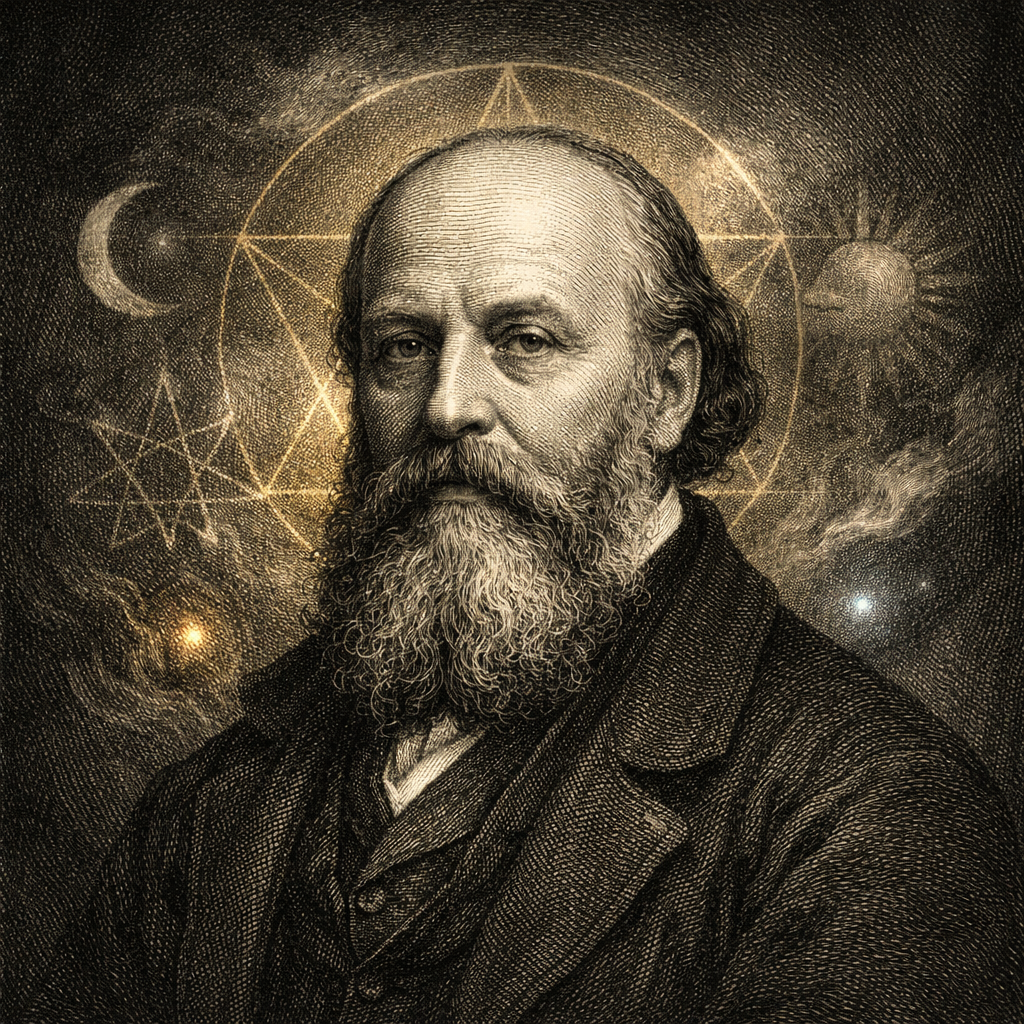
Date range: 1810–1875
Brief Biography
Éliphas Lévi, born Alphonse Louis Constant, was a French occult writer, former seminarian, socialist sympathiser, ceremonial magician, and one of the central architects of the nineteenth-century occult revival. Born in Paris in 1810, he was educated for the Catholic priesthood but never settled into clerical life, moving instead through radical politics, mystical speculation, and eventually esoteric writing. Under the name Éliphas Lévi, a Hebraicised form of his given name, he developed a powerful synthesis of magic, Kabbalah, tarot, symbolism, and Christian esotericism. His major work, Dogme et Rituel de la Haute Magie, helped establish the vocabulary and symbolic structure of modern occultism. Lévi died in 1875, but his influence continued through the Theosophical Society, the Hermetic Order of the Golden Dawn, modern Qabalah, Thelema, and later magical and neo-pagan currents.
Works and Texts
- Dogme et Rituel de la Haute Magie
- The Tarot of the Bohemians
Place in the Western Esoteric Tradition
Éliphas Lévi occupies a decisive place in the Western Esoteric Tradition as one of the chief reformulators of modern occult philosophy. He gathered elements from speculative Freemasonry, Illuminism, Christian theosophy, high-degree Masonry, grimoires, ceremonial magic, and early occult tarot into a language that later nineteenth- and twentieth-century esoteric movements could readily inherit. His importance lies in the symbolic architecture he gave to magic: the magician as disciplined will, the astral light as mediating field, tarot as a key to universal symbolism, and Kabbalah as an organising grammar of hidden correspondences. Lévi did not simply preserve older material. He gave it a dramatic modern form, sufficiently grand to inspire generations and sufficiently elastic to let them argue over it forever, as occultists apparently must.
Lévi’s Mystical System
Éliphas Lévi’s mystical system is organised around the disciplined imagination, the trained will, and the symbolic structure of the universe. His occultism is not a collection of isolated magical techniques. It is a vision of reality in which visible forms, religious symbols, ritual gestures, words, images, and celestial patterns participate in a hidden order. Magic is the art of acting consciously within that order.
At the centre of Lévi’s system is the will. The magician is not a passive dreamer, a superstitious operator, or a collector of forbidden recipes. He is a disciplined intelligence capable of directing imagination, desire, speech, and symbolic action toward a chosen end. Lévi’s magician must master himself before he can claim mastery over anything else. This emphasis on will gave later occultism one of its most enduring themes. Magical power became inseparable from concentration, moral formation, symbolic literacy, and command of the inner life.
Lévi’s account of the astral light is equally central. He describes a subtle medium through which images, forces, influences, and impressions circulate. The astral light functions as a bridge between mind and matter, spirit and form, imagination and manifestation. It carries the traces of human thought and desire, and it provides the field in which magical operations take effect. This idea allowed Lévi to explain ritual, divination, fascination, apparitions, and occult influence within a single conceptual framework. The unseen world was not chaotic. It was a living medium shaped by will, symbol, and correspondence.
The symbolic imagination is the working faculty of Lévi’s magic. Symbols are not decorative signs attached to doctrines already known by other means. They are instruments through which hidden relations become visible. Lévi’s famous images, especially the goat of Mendes or Baphomet, show his method clearly. The image condenses polarity, equilibrium, generative force, spiritual ascent, animal nature, and initiatory knowledge into one emblem. Such symbols are designed to be read, contemplated, and ritually activated. They do not explain themselves politely, because symbols have more dignity than committee minutes.
Lévi’s use of tarot marks a turning point in the history of occult symbolism. Earlier writers had already argued for the ancient and esoteric meaning of the cards, but Lévi gave tarot a more systematic place within occult philosophy. He linked the tarot trumps with the Hebrew alphabet and interpreted the deck as a key to the universal doctrine of correspondences. Tarot became a symbolic book, an initiatory sequence, and a practical instrument of magical interpretation. Later occultists would revise his attributions and challenge his claims, but they inherited his central gesture: tarot as a structured esoteric language.
Kabbalah plays a similar organising role in Lévi’s thought. His Kabbalah was not a careful historical presentation of Jewish mystical tradition in the modern scholarly sense. It was an occult and Christianised symbolic grammar, used to order divine names, letters, numbers, hierarchies, and correspondences. Through this grammar, Lévi connected magic to sacred language and cosmic structure. The divine name, the Hebrew letter, the number, the emblem, and the ritual act could all be placed within a single symbolic economy.
Lévi also transformed the legacy of grimoires. Earlier ritual magic often appeared in the form of conjurations, talismans, planetary operations, angelic and demonic names, and ceremonial instructions. Lévi recast this material through a philosophical and moral lens. True magic, in his account, is not servile trafficking with spirits. It is the science of equilibrium, analogy, and will. The magician works lawfully by understanding the hidden structure of nature and spirit. This distinction allowed Lévi to elevate magic from illicit operation into spiritual philosophy, though the old grimoire atmosphere never entirely disappears.
Equilibrium is one of his most important principles. Lévi repeatedly thinks through polarity: active and passive, light and shadow, mercy and severity, spirit and matter, freedom and law. Magical power depends on balance rather than excess. The initiate must understand opposition as a condition of manifestation. This gives Lévi’s system a characteristic architecture of paired forces and reconciled contraries. The magician stands at the centre, not as a tyrant over nature, but as a conscious mediator of opposing powers.
His relation to Christianity is complex. Lévi rejected narrow clerical authority but retained a deeply sacramental and symbolic imagination shaped by Catholicism. He read Christian doctrine, ritual, and imagery as veils of esoteric truth. The cross, the Eucharist, the priesthood, the Virgin, the devil, and the apocalypse could all be interpreted symbolically and magically. This gave his occultism a recognisably Christian texture even when it moved far outside official theology. His system is anti-materialist, hierarchical, symbolic, and concerned with redemption through knowledge and disciplined transformation.
Lévi’s historical importance lies in the form he gave to the occult revival. He made magic intellectually ambitious, aesthetically powerful, and rhetorically modern. Later figures and movements drew heavily on his ideas: the Theosophical Society absorbed aspects of his symbolic and occult vocabulary; the Golden Dawn developed ritual systems shaped in part by his tarot and Kabbalistic synthesis; Waite, Fortune, Crowley, and others defined themselves through direct inheritance, revision, or resistance. Even when later occultists corrected him, they often did so from within a framework he had helped create.
Lévi’s mystical system may therefore be understood as a philosophy of magical mediation. The universe is structured by correspondences. Symbols reveal and organise those correspondences. The astral light carries impressions between visible and invisible worlds. The disciplined will acts through imagination and ritual. Tarot, Kabbalah, grimoire magic, Christian symbolism, and Masonic-theosophical currents are gathered into a single dramatic vision of initiation. His work gave modern occultism one of its most enduring forms: magic as the conscious direction of symbolic power within a living cosmos.
Antecedent Figures
- Andrew Michael Ramsay
- Antoine Court de Gébelin
- Elias Ashmole
- Emanuel Swedenborg
- Jacob Boehme
- James Anderson
- Jean-Baptiste Alliette (Etteilla)
- Jean-Baptiste Willermoz
- Louis-Claude de Saint-Martin
- Martinez de Pasqually
- William Preston
Antecedent Traditions
- Speculative Freemasonry
- Illuminism & Christian Theosophy
- High-Degree Masonry
- Renaissance Grimoires
- Early Tarot
Succeeding Figures
- Aleister Crowley
- Annie Besant
- Arthur Edward Waite
- Charles Webster Leadbeater
- Dion Fortune
- Gerald Gardner
- Helena Petrovna Blavatsky
- S.L. MacGregor Mathers
- William Wynn Westcott
Succeeding Traditions
- Thelema
- Neo-Paganism/Wicca
- Modern Qabalah
- Hermetic Order of the Golden Dawn
- Theosophical Society