Elias Ashmole
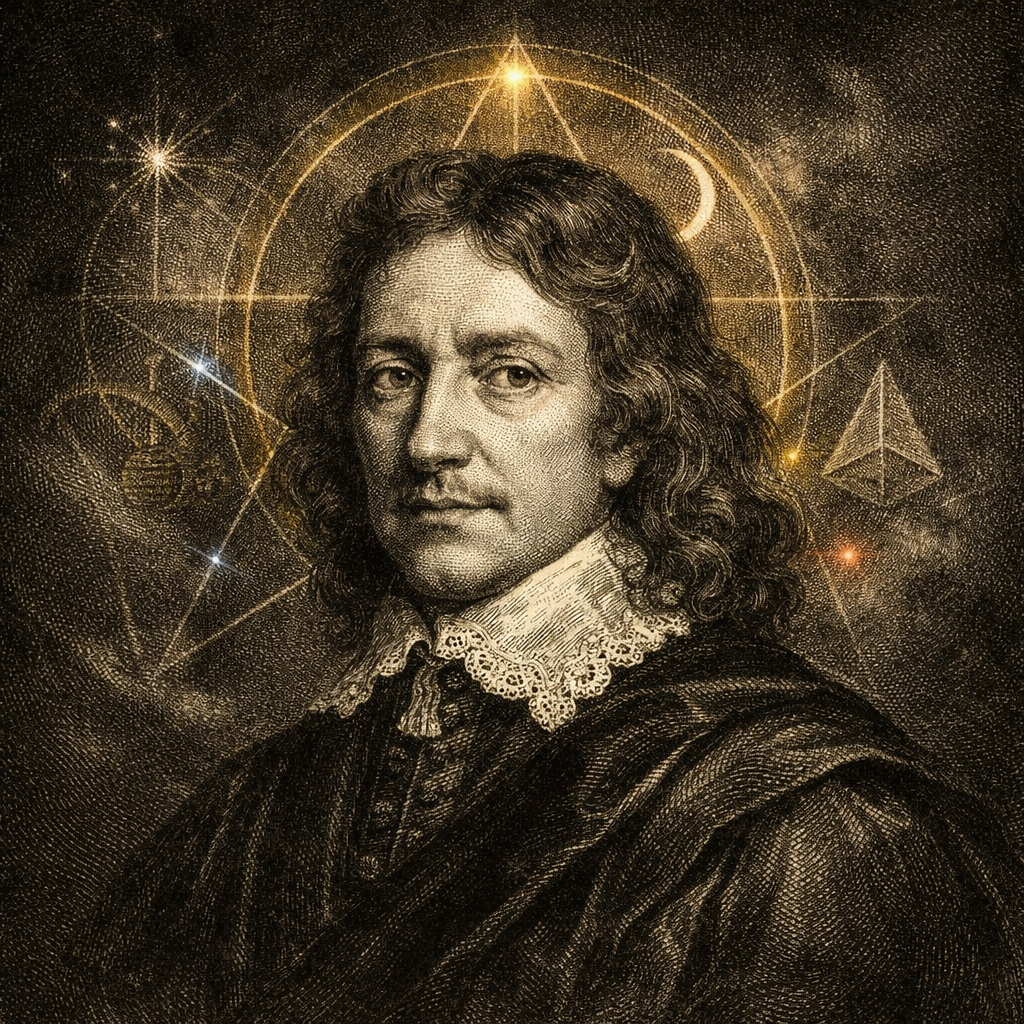
Date range: 1617–1692
Brief Biography
Elias Ashmole was an English antiquary, astrologer, alchemical collector, herald, diarist, and one of the earliest recorded speculative Freemasons in England. Born in Lichfield in 1617, he lived through the Civil War, Commonwealth, and Restoration, serving in administrative and heraldic roles while pursuing wide-ranging antiquarian and esoteric interests. Ashmole is especially important for his 1646 diary entry recording his initiation into a Masonic lodge at Warrington, one of the earliest clear records of a non-operative gentleman being admitted into Masonry. His collection of manuscripts, coins, curiosities, and natural and artificial rarities helped form the basis of the Ashmolean Museum at Oxford. He died in 1692, leaving a legacy that links antiquarianism, alchemy, early scientific culture, heraldry, and the emergence of speculative Freemasonry.
Works and Texts
- The Constitutions of the Free-Masons
- Illustrations of Masonry
- Theatrum Chemicum Britannicum
Place in the Western Esoteric Tradition
Ashmole occupies an important place in the Western Esoteric Tradition because he stands at a point of transition between Renaissance esoteric culture, operative craft traditions, antiquarian scholarship, and the beginnings of recorded speculative Freemasonry. His interests in alchemy, astrology, heraldry, manuscript preservation, and ancient institutions reflect a world in which the recovery of old knowledge remained intellectually serious. His recorded Masonic initiation made him a key figure in later attempts to understand how operative masonry became a symbolic and philosophical institution. Ashmole did not create speculative Freemasonry, but his life brings together many of the forces that helped make it imaginable: antiquarian memory, ritual affiliation, alchemical symbolism, sacred history, and the learned fascination with hidden continuities.
Ashmole’s Mystical System
Elias Ashmole’s mystical system is best understood as an antiquarian and alchemical vision of hidden continuity. He did not produce a single systematic doctrine of esoteric ascent, nor did he found a ritual movement. His importance lies in the pattern of interests that converged in his life: alchemy, astrology, heraldry, Masonry, manuscript collection, genealogy, ceremonial order, and the preservation of ancient knowledge. Taken together, these interests reveal a mind drawn to signs, lineages, correspondences, and inherited forms of authority.
Ashmole belonged to a seventeenth-century intellectual world in which the boundaries between science, antiquarianism, natural magic, and esoteric speculation were still fluid. Learned men could study mathematics, astronomy, medicine, astrology, alchemy, history, and sacred chronology without arranging them into the modern compartments that later scholarship would impose with such grim satisfaction. For Ashmole, the past was not dead material. It was an archive of meanings, institutions, and symbolic orders whose recovery could illuminate the present.
His alchemical work is central to this outlook. Theatrum Chemicum Britannicum, published in 1652, gathered and preserved English alchemical poetry and related materials. The collection is not simply a literary anthology. It presents English alchemy as a venerable and meaningful tradition, worthy of recovery and transmission. Ashmole treated alchemical writings as vessels of concealed wisdom, encoded in allegory, myth, emblem, and symbolic language. Alchemy, in this setting, was not only a matter of laboratory transmutation. It was also a discipline of interpretation, preservation, and spiritualised natural philosophy.
The alchemical imagination gave Ashmole a model for hidden order. Nature concealed powers and processes beneath visible appearances. Texts concealed doctrines beneath veils of fable and metaphor. Institutions preserved memory beneath ritual and custom. This habit of mind is deeply relevant to the later development of speculative Freemasonry. Masonic symbolism would come to operate in a similar way: tools, buildings, legends, and ceremonies were read as carriers of moral, spiritual, and philosophical meaning.
Ashmole’s recorded initiation into Masonry in 1646 is therefore historically significant beyond the bare fact of membership. It places him at an early point in the documented admission of gentlemen into lodges associated with the building craft. The meaning of that admission remains debated, and caution is necessary. A single diary entry does not explain the whole transformation from operative guild to speculative fraternity. It does, however, show that learned and socially prominent men with antiquarian and esoteric interests were entering Masonic settings before the formal emergence of Grand Lodge Freemasonry in the eighteenth century.
The connection between Ashmole and operative Masonic guilds is important because it marks the survival and reinterpretation of craft identity. Medieval and early modern building traditions carried legends of origins, saints, charges, duties, and moral expectations. Later speculative Freemasonry would turn such materials into a symbolic system of moral architecture. Ashmole’s position at this threshold has made him a natural point of reference for those seeking the roots of speculative Masonry in older craft, Rosicrucian, alchemical, or Hermetic environments.
The Rosicrucian dimension of Ashmole’s significance is more a matter of atmosphere and affinity than simple institutional membership. The Rosicrucian manifestos had circulated earlier in the seventeenth century, promising reform, hidden wisdom, and a fraternity of enlightened adepts. Their themes resonated with the same world that nourished alchemical, Hermetic, and reforming intellectual projects. Ashmole’s collecting, editing, and interest in esoteric traditions belong to this broader culture of concealed wisdom and learned restoration. The Rosicrucian ideal of a hidden fraternity dedicated to knowledge and reform would later intersect strongly with Masonic myth and high-grade systems.
Ashmole’s antiquarianism also shaped his esoteric importance. As a herald and collector, he was concerned with lineage, signs, emblems, arms, precedence, ceremony, and the preservation of memory. Heraldry and Masonry may seem distant from alchemy, but both depend on disciplined symbolic reading. A coat of arms, a ritual title, a legendary origin, or an alchemical emblem can all be treated as compressed forms of meaning. Ashmole’s world trained the mind to read visible marks as signs of invisible order.
The texts listed around Ashmole also show how later Masonic culture understood his position. The Constitutions of the Free-Masons and Illustrations of Masonry belong to later stages of Masonic self-definition and exposition. Their inclusion alongside Theatrum Chemicum Britannicum draws attention to a larger historical arc: from alchemical preservation and early speculative admission to the eighteenth-century articulation of Freemasonry as a moral and symbolic institution. Ashmole stands near the beginning of that arc, not as its architect, but as one of its most suggestive witnesses.
His place in relation to later high-degree Masonry, Christian theosophy, Illuminism, and the occult revival follows from this symbolic role. Later systems would elaborate Masonry into chivalric, theosophical, magical, and initiatory structures. They often searched for ancient sources, hidden transmissions, and esoteric lineages. Ashmole’s life seemed to offer a bridge between learned esoteric culture and Masonic affiliation. Whether later claims about that bridge were always historically secure is another question, and the answer is often no, because tradition has never been shy about improving the past when the past proves insufficiently decorative.
Ashmole’s mystical system may therefore be described as a culture of esoteric preservation. He gathered fragments, recorded affiliations, edited alchemical poetry, studied symbolic disciplines, and moved through institutions where lineage and ceremony mattered. His importance lies in the way these activities helped preserve materials and associations that later esoteric and Masonic writers would interpret as signs of a deeper continuity. He stands as a custodian at a historical threshold: between Renaissance Hermetic and alchemical culture, operative craft memory, and the rise of speculative Freemasonry as a symbolic and initiatory tradition.
Antecedent Figures
- Giordano Bruno
- Giovanni Pico della Mirandola
- Heinrich Cornelius Agrippa
- Johann Valentin Andreae
- Johannes Reuchlin
- King Athelstan (Legendary)
- Marsilio Ficino
- Michael Maier
- Robert Fludd
Antecedent Traditions
- Rosicrucianism
- Operative Masonic Guilds
- Renaissance Christian Kabbalah & Hermetic Magic
Succeeding Figures
- Andrew Michael Ramsay
- Emanuel Swedenborg
- Jacob Boehme
- Jean-Baptiste Willermoz
- Louis-Claude de Saint-Martin
- Martinez de Pasqually
- Papus (Gérard Encausse)
- Éliphas Lévi
Succeeding Traditions
- High-Degree Masonry
- Illuminism & Christian Theosophy
- Occult Revival & Ritual Magic