Egyptian Religion
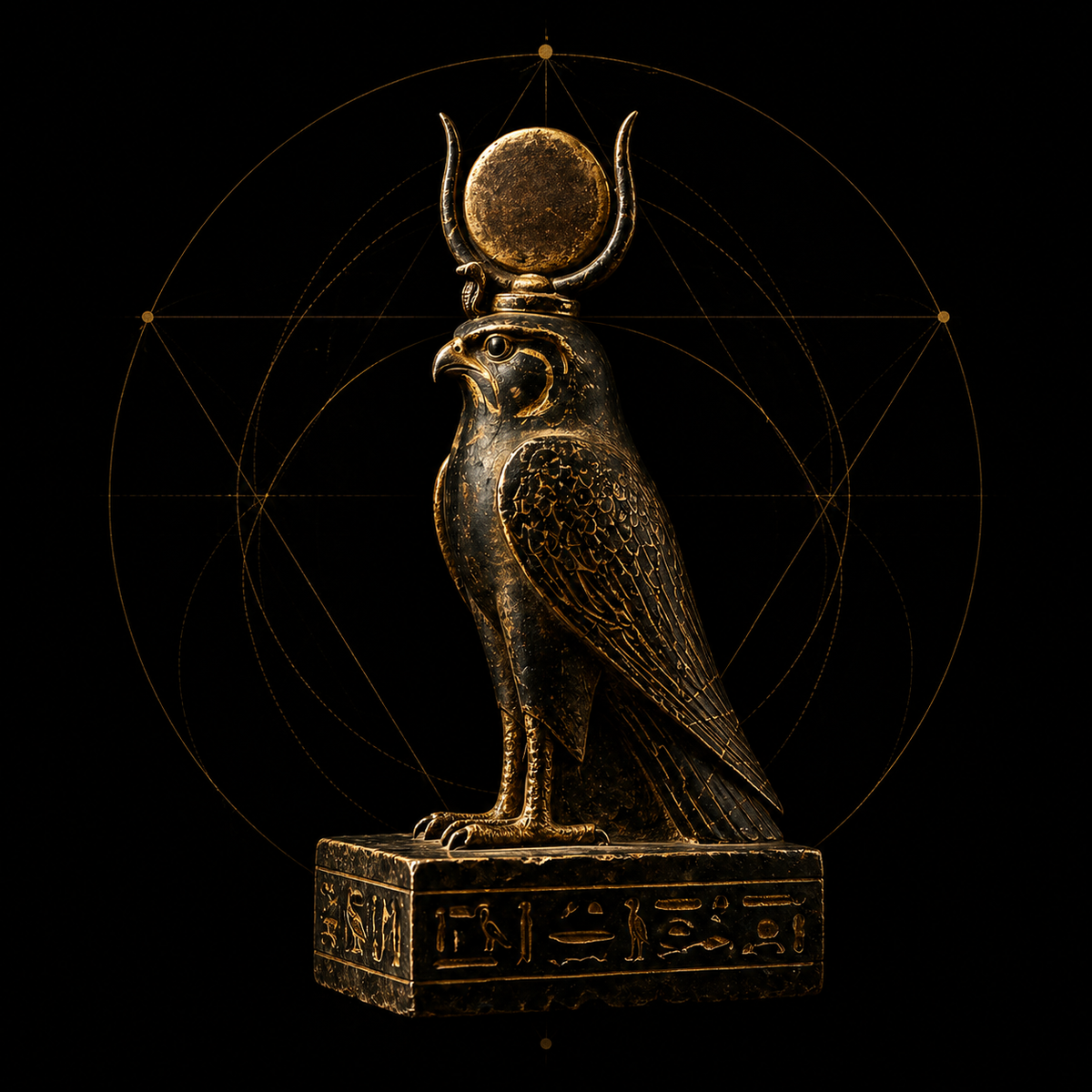
Egyptian religion occupies a distinctive and formative place in the development of the Western Esoteric Tradition. Its influence is not always direct, and it should not be reduced to the romantic fantasy of Egypt as the single hidden source of all wisdom. That notion belongs more to later European imagination than to careful historical method. Yet Egypt did provide one of the most powerful symbolic and religious reservoirs from which late antique, Hermetic, magical, alchemical, Masonic, and occult traditions repeatedly drew. Its gods, ritual forms, funerary texts, cosmologies, priestly imagery, and monumental architecture furnished later esoteric systems with a language of sacred kingship, cosmic order, divine mediation, death, rebirth, and hidden wisdom.
At the heart of Egyptian religion was the conviction that the visible and invisible worlds were bound together through order, ritual, and divine presence. The concept of ma’at expressed truth, balance, justice, right order, and cosmic harmony. It was not merely an ethical principle, but a metaphysical one. The world endured because divine order was continually maintained against chaos. Ritual was therefore not decorative or symbolic in the thin modern sense. It was an active participation in the preservation of the cosmos. Temples, offerings, hymns, images, and priestly actions were understood as means by which divine order was renewed and made effective in the world.
This ritual worldview profoundly shaped later esoteric imagination. Egyptian religion presented the universe as a sacred structure in which material forms could embody divine powers. Statues were not simply representations of gods; under appropriate ritual conditions, they could become vessels of divine presence. Sacred words, names, gestures, images, and objects possessed operative force. This understanding of symbol as active rather than merely illustrative would become a major theme in later Hermetic and magical traditions. The idea that properly consecrated forms could mediate spiritual power runs through theurgy, talismanic magic, ceremonial ritual, and many later systems of occult correspondence.
The figure of Thoth is especially important in this transmission. As the god of writing, measurement, wisdom, calculation, ritual knowledge, and divine speech, Thoth became identified in the Hellenistic period with Hermes, producing the composite figure Hermes Trismegistus. This fusion was decisive. Through Hermes-Thoth, Egyptian priestly wisdom was reimagined in Greek philosophical and religious terms, eventually giving rise to the Hermetic literature of late antiquity. Whether or not the Corpus Hermeticum preserves authentically ancient Egyptian doctrine in any straightforward sense is beside the point historically. What matters is that Egypt became the imagined homeland of a primordial wisdom mediated through Hermes, a figure at once scribe, revealer, magician, philosopher, and guide of souls.
Egyptian funerary religion also contributed enduring themes to esoteric thought. Texts such as the Pyramid Texts and the Book of the Dead describe the soul’s passage beyond death, its encounters with divine powers, its judgment, and its hoped-for transformation into a transfigured spiritual being. These traditions are not identical with later doctrines of spiritual ascent, initiation, or occult rebirth, but they helped establish a symbolic vocabulary in which death could be understood as passage, testing, purification, and transformation. Later esoteric systems often treated initiation as a symbolic death and rebirth, and Egypt supplied especially compelling imagery for this pattern. Tomb, temple, darkness, judgment, resurrection, and solar renewal all became part of the broader esoteric grammar of transformation.
The Egyptian temple also became a lasting model of sacred architecture. Temples were arranged as ordered spaces moving from the public and visible toward the hidden and holy. Their architecture enacted a passage from outer world to inner sanctuary, from brightness to mystery, from multiplicity to divine concentration. This spatial symbolism later resonated strongly with initiatory traditions, including forms of Freemasonry and ritual magic, where movement through symbolic space becomes a means of moral, spiritual, or intellectual formation. Again, the influence is not always direct. Later traditions often inherited an imagined Egypt as much as an historical one. But imagined Egypt was itself historically powerful, and it became one of the great symbolic engines of Western esotericism.
The Hellenistic transformation of Egyptian religion was especially significant. Under Greek and Roman rule, Egyptian gods and myths entered a cosmopolitan religious environment. Isis worship spread widely through the Mediterranean. Serapis embodied a fusion of Egyptian and Hellenistic religious forms. Egyptian priestly wisdom was increasingly interpreted through Greek philosophical categories. This was the cultural world in which Hermeticism emerged: neither purely Egyptian nor simply Greek, but a syncretic religious and philosophical formation that treated Egypt as the privileged site of ancient revelation. In that environment, Egyptian religion became one of the central sources from which late antique esoteric thought drew its authority, symbols, and sacred atmosphere.
For the Western Esoteric Tradition, the importance of Egyptian religion lies less in a continuous institutional lineage than in a durable symbolic and ritual inheritance. It offered later traditions a model of the cosmos as sacred order, of ritual as effective action, of divine names and images as vehicles of power, of death as transformation, and of wisdom as something both ancient and veiled. The Egypt of later esotericism was often reconstructed, idealised, and misunderstood, because apparently the human imagination cannot encounter ruins without immediately building a metaphysical franchise upon them. Yet even through these distortions, Egyptian religion remained one of the great formative presences in the esoteric imagination.
Its immediate mapped significance is its influence upon Late Antique Hermeticism and Gnosticism. Through the fusion of Hermes and Thoth, through the prestige of Egyptian priesthood, and through the wider Hellenistic fascination with ancient wisdom, Egyptian religion helped shape the atmosphere in which Hermetic revelation, spiritual ascent, divine knowledge, and sacred cosmology could be articulated. It did not create the Western Esoteric Tradition by itself, but it gave that tradition some of its most enduring images: the hidden temple, the sacred word, the wise priest, the journey after death, and the ancient wisdom concealed beneath symbolic form.
Antecedent Traditions
· None mapped
Succeeding Traditions
· Late Antique Hermeticism & Gnosticism