Edward Kelley
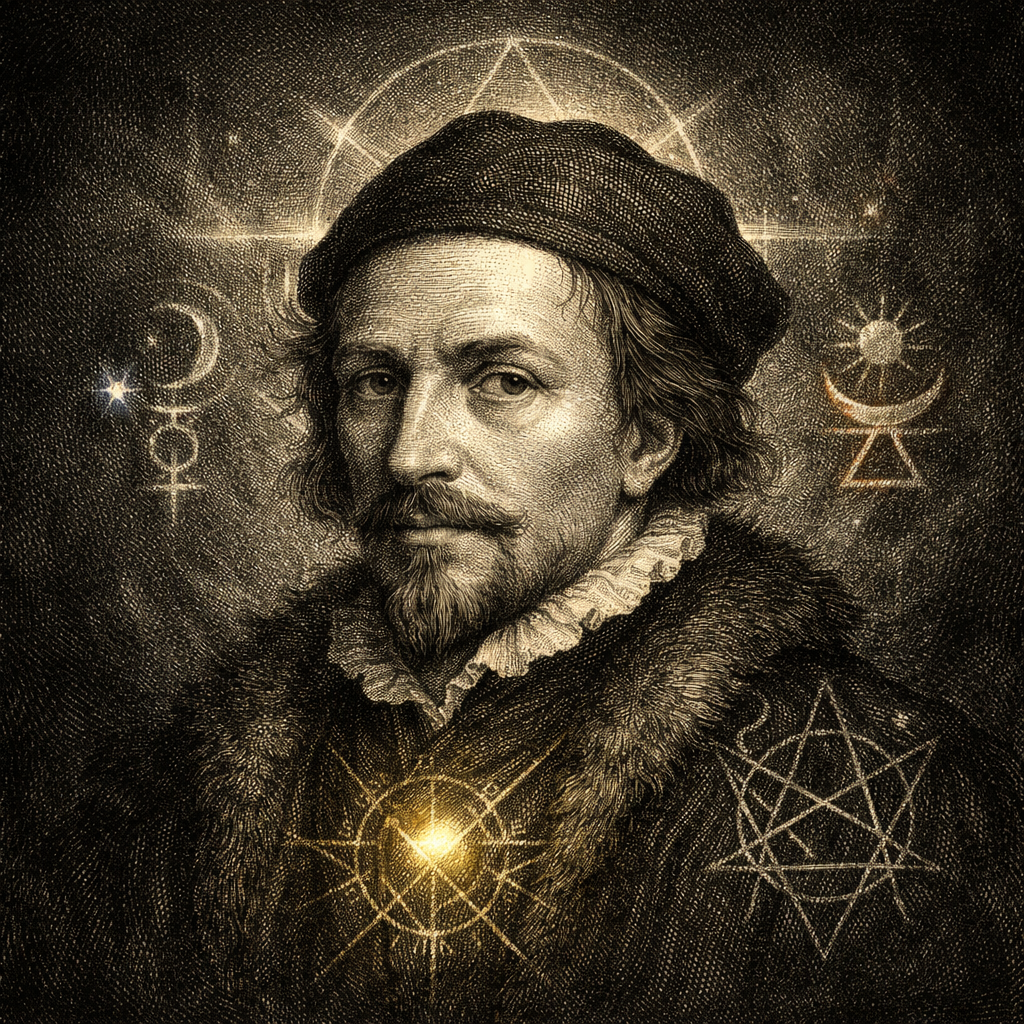
Date range: 1555–1597/1598
Brief Biography
Edward Kelley was an English scryer, alchemical practitioner, and occult associate of John Dee, best known for his role in the angelic communications recorded in Dee’s spiritual diaries. Born around 1555, Kelley entered Dee’s circle in the early 1580s and became the principal medium through whom Dee believed angelic intelligences communicated. Their work together produced a complex body of material involving angelic language, ritual instruction, cosmology, and visionary revelation, later known as Enochian magic. Kelley’s reputation was divided even in his own lifetime: to some he appeared as a gifted seer and alchemist, to others as a fraud, opportunist, or dangerous visionary. He spent later years on the Continent, especially in Bohemia, where he became involved in alchemical patronage and imperial circles. He died in the late 1590s, probably after imprisonment, leaving a legacy that has remained inseparable from the development of angelic and ceremonial magic.
Works and Texts
- Monas Hieroglyphica
- Dee’s Enochian Diaries
Place in the Western Esoteric Tradition
Edward Kelley occupies an important place in the Western Esoteric Tradition because he was the visionary instrument through whom one of the most elaborate systems of early modern angelic magic entered the historical record. His work with John Dee stands within the world of Renaissance Christian Kabbalah and Hermetic magic, where learned occultists sought divine wisdom through sacred language, mathematics, astrology, ritual, and angelic mediation. Kelley’s significance lies in the production of the Enochian material: angelic calls, tables, names, cosmological structures, and visionary instructions that later shaped Rosicrucian currents and the ritual magic of the Hermetic Order of the Golden Dawn. Whether Kelley is treated as seer, collaborator, trickster, or unstable genius, his role in the transmission of Enochian magic is unavoidable.
Kelley’s Mystical System
Edward Kelley’s mystical system is difficult to isolate from the work of John Dee, since the surviving record is largely preserved through Dee’s diaries and framed by Dee’s theological, mathematical, and angelological ambitions. Kelley’s role, however, was not incidental. He served as the principal scryer, the person through whom the angelic visions, voices, letters, and instructions were received. The system that emerged from this collaboration depends on the belief that divine or angelic intelligences could communicate through disciplined visionary practice and disclose a sacred language capable of restoring lost knowledge.
The centre of the Kelley-Dee material is angelic mediation. The angels are presented as bearers of divine wisdom, not as symbolic abstractions or poetic ornaments. They communicate names, tables, prayers, cosmological schemes, and ritual instructions. This places the work within a Renaissance world in which learned magic could be imagined as a sacred science, provided it was directed toward divine illumination rather than demonic coercion. The ambition was immense: to recover a purer form of knowledge through direct contact with heavenly intelligences.
Kelley’s visionary method relied on scrying, usually through a crystal or show-stone. Dee would record the sessions, question the angels, and interpret the material within his wider intellectual framework. Kelley described what he saw and heard. The resulting diaries are among the most detailed records of early modern angelic practice. They preserve a ritual and visionary process in which the boundary between prayer, experiment, revelation, and magical operation becomes unusually thin.
The angelic language is the most famous element of the system. Dee and Kelley received letters, words, and calls that later occultists came to describe as Enochian. This language was understood as more than a code or cipher. It was treated as a sacred tongue with primordial and angelic significance, connected with the recovery of wisdom lost after the Fall. Its reception gave the system linguistic authority: revelation appeared not only as doctrine, but as speech. The divine order could be heard, written, arranged, and ritually pronounced.
The tables and names associated with the Enochian material also show the Renaissance concern with ordered correspondences. Letters, directions, angels, elements, and cosmic regions are arranged into patterned structures. These structures imply that the unseen world is not chaotic, but governed by intelligible hierarchies. To know the names and relations of these powers is to gain access to a hidden architecture of creation. This is one reason the material later appealed so strongly to ritual magicians. It offered both visionary grandeur and technical structure, a combination to which ceremonial magic has always been dangerously susceptible.
Kelley’s place in the system is marked by ambiguity. Dee’s intellectual and devotional aims were comparatively clear: he sought the restoration of wisdom, the reform of knowledge, and communication with angels under divine authority. Kelley’s motives are harder to fix. He may have been a sincere visionary, a volatile medium, a manipulator, or some shifting mixture of all three. The difficulty is part of his historical significance. Western esotericism repeatedly depends on intermediaries whose authority is both essential and unstable. Kelley embodies that problem with almost theatrical efficiency.
The more troubling episodes in the diaries sharpen this ambiguity. Some communications pressed Dee and Kelley into morally and emotionally difficult territory, including instructions that strained the boundaries of Dee’s piety and personal life. These moments reveal the dangers inherent in revelatory systems based on mediumship. Once authority is assigned to a voice from beyond the ordinary world, discernment becomes urgent and perilous. Kelley’s visions could elevate, instruct, confuse, or destabilise. The same channel that promised angelic wisdom could also generate crisis.
The alchemical dimension of Kelley’s life adds another layer. On the Continent, he gained a reputation as an alchemist and became involved with patrons interested in transmutation. This reputation connected him to the broader Hermetic and alchemical currents of the late Renaissance. Alchemy and angelic magic shared an expectation that nature concealed divine secrets and that disciplined operation might recover them. Kelley’s life therefore joins two powerful strands of early modern esotericism: the transformation of matter and the reception of heavenly speech.
The later history of Kelley’s material is decisive. The Enochian diaries did not remain a closed Elizabethan curiosity. They became a reservoir for later Rosicrucian and ceremonial magical currents. The Hermetic Order of the Golden Dawn systematised and ritualised Enochian material in new ways, placing it within a broader framework of Kabbalah, elemental magic, initiation, and astral work. Through that transmission, Kelley’s visions entered modern occult practice far beyond their original setting.
Kelley’s mystical system may therefore be understood as visionary angelic mediation. Its core elements are scrying, sacred language, angelic hierarchy, revealed tables, and the recovery of divine wisdom through communication with higher intelligences. It is a system marked by splendour and risk. Its splendour lies in the extraordinary symbolic and linguistic architecture it produced. Its risk lies in the uncertain authority of the medium and the instability of revelation when filtered through human desire, fear, ambition, and imagination.
Kelley’s enduring importance rests on this paradox. He was not the principal theorist of the system that bears the later name of Enochian magic, yet without him the system would scarcely exist. He stands as the seer at the threshold: the figure through whom angels spoke, symbols appeared, and a new magical language entered the Western esoteric archive. His legacy remains powerful because it preserves one of the central questions of the tradition: how does one distinguish divine revelation from the theatre of the visionary mind?
Antecedent Figures
- Giordano Bruno
- Giovanni Pico della Mirandola
- Heinrich Cornelius Agrippa
- Johannes Reuchlin
- Marsilio Ficino
Antecedent Traditions
- Renaissance Christian Kabbalah & Hermetic Magic
Succeeding Figures
- Arthur Edward Waite
- Johann Valentin Andreae
- Michael Maier
- Robert Fludd
- S.L. MacGregor Mathers
- William Wynn Westcott
Succeeding Traditions
- Rosicrucianism
- Hermetic Order of the Golden Dawn