Dion Fortune
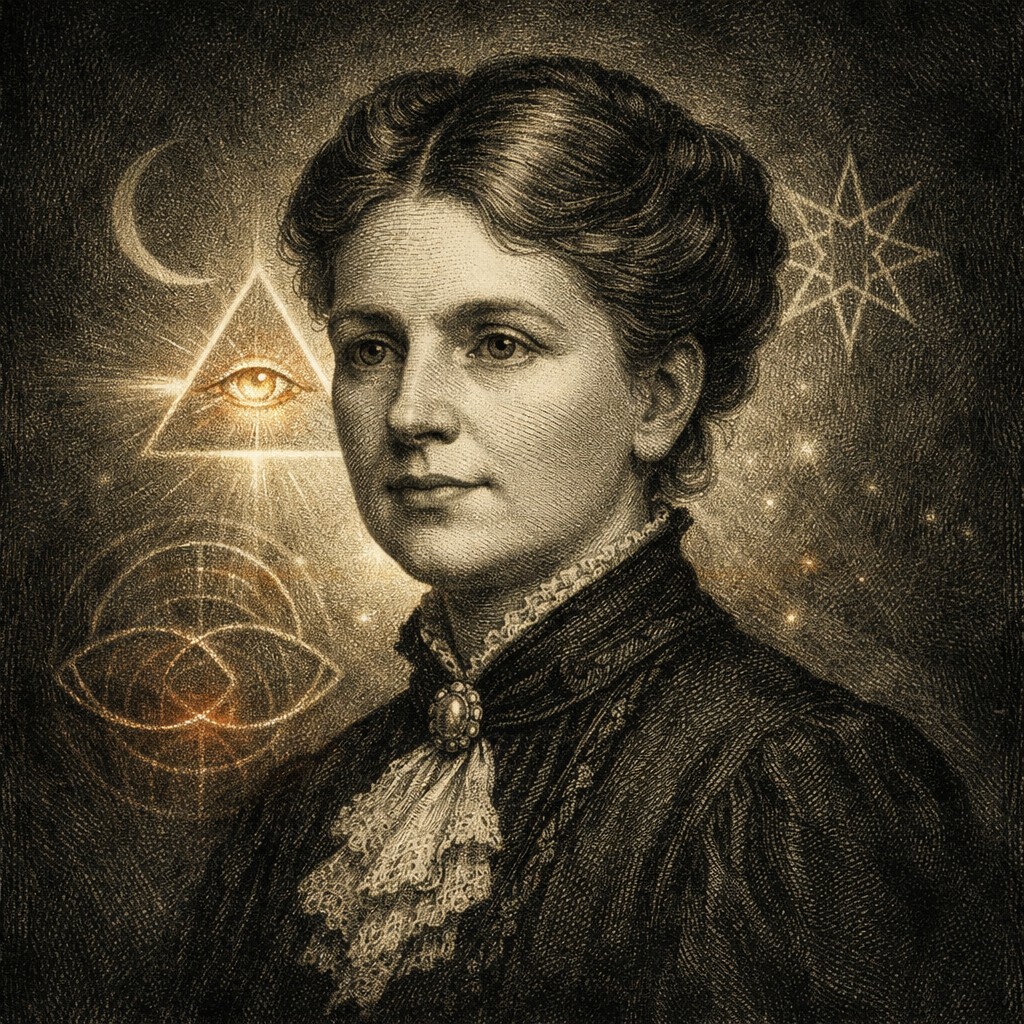
Date range: 1890–1946
Brief Biography
Dion Fortune, born Violet Mary Firth, was a British occultist, writer, ceremonial magician, novelist, and founder of the Fraternity of the Inner Light. Trained in the psychological and occult currents of the early twentieth century, she became one of the most influential interpreters of practical Qabalah and Western magical philosophy for modern readers. Her work joined ritual magic, Christian mysticism, psychology, psychic development, and esoteric symbolism into a disciplined but accessible system. Fortune wrote both instructional works and occult fiction, using each form to explore the dynamics of initiation, spiritual power, inner-plane contact, and magical responsibility. She died in 1946, leaving a body of writing that helped shape twentieth-century British occultism and remains a major point of entry into the Western Mystery Tradition.
Works and Texts
- The Mystical Qabalah
Place in the Western Esoteric Tradition
Dion Fortune occupies an important place in the Western Esoteric Tradition as one of the clearest modern expositors of practical Qabalah and the Western Mystery Tradition. Her significance lies in the way she translated complex occult symbolism into a disciplined framework for spiritual development, psychological integration, and magical practice. Drawing from the occult revival and ritual magical currents associated with figures such as Éliphas Lévi and Papus, Fortune presented the Tree of Life as a living map of consciousness, cosmos, initiation, and divine manifestation. Her work helped make Qabalistic symbolism intelligible to modern seekers without stripping it of ritual and contemplative seriousness. A rare achievement, since many introductions to occultism manage either to mystify the simple or flatten the profound, sometimes in the same paragraph.
Fortune’s Mystical System
Dion Fortune’s mystical system is centred on the Tree of Life as a symbolic map of reality and consciousness. In The Mystical Qabalah, the Tree is presented as a pattern through which the relation between God, the universe, and the human soul may be understood. It is at once cosmological, psychological, magical, and devotional. Its value lies in its capacity to hold multiple orders of meaning together without reducing one to another.
Fortune’s Qabalah is practical rather than merely speculative. The Tree of Life is not treated as an abstract diagram for intellectual amusement. It is a working glyph, a symbolic instrument through which the student may train imagination, discipline thought, organise spiritual experience, and approach the hidden structure of existence. Each sephirah represents a mode of divine manifestation, a level of consciousness, a field of symbolic correspondences, and a stage in the unfolding of spiritual life.
This practical orientation places Fortune within the wider occult revival and ritual magical tradition. She inherited a world in which Kabbalah, tarot, astrology, ceremonial magic, colour symbolism, divine names, and initiatory grades had been brought into complex relation. Her contribution was to present this material with unusual clarity and restraint. She did not treat Qabalah as a decorative collection of correspondences. She treated it as a disciplined system of spiritual training, capable of shaping the mind and ordering experience.
The Tree of Life, in Fortune’s account, provides a bridge between macrocosm and microcosm. The structure of the cosmos and the structure of the soul mirror one another. Divine reality descends through successive stages of manifestation, from the most abstract and hidden principles to the density of the material world. The aspirant, moving in the opposite direction, learns to ascend through contemplation, ethical refinement, magical discipline, and imaginative participation in the symbols of the Tree.
Fortune’s approach is deeply psychological. Her early involvement with psychotherapy and her wider interest in the unconscious shaped her understanding of magical work. Symbols are not only signs of external metaphysical realities. They are also instruments that affect the deep layers of the psyche. Magical practice requires care because symbols can awaken forces within the practitioner that must be integrated rather than merely aroused. This gave her esotericism a sobriety sometimes missing from more theatrical forms of occultism, because apparently lighting candles and invoking archangels does not exempt anyone from emotional housekeeping.
Her treatment of the sephiroth reflects this union of cosmology and psychology. Malkuth corresponds to the material world and embodied life; Yesod to the imaginal, lunar, and formative levels of consciousness; Tiphareth to harmony, sacrifice, beauty, and the higher self; Kether to the divine crown beyond ordinary comprehension. The path of ascent through the Tree is therefore also a path of interior reorganisation. The aspirant learns to understand the forces operating within the self and the universe, and to bring them into right relation.
Fortune’s system is also religious in tone. Although she wrote within an occult framework, her work often carries a devotional and Christian-inflected sensibility. The Western Mystery Tradition, as she understood it, was not a rejection of religion but a deepening of symbolic and spiritual understanding. Ritual and meditation were means of approaching divine reality through the ordered use of sacred forms. Magic was not simply the manipulation of hidden forces. At its highest, it was cooperation with spiritual law.
This concern with law and responsibility is central to Fortune’s magical ethics. Power without balance is dangerous. Psychic development without moral formation is unstable. Ritual work without psychological discipline can inflate the personality or disturb the inner life. Fortune repeatedly emphasises training, structure, and gradual development. The student must learn to think clearly, imagine accurately, feel deeply without being overwhelmed, and act within a framework of spiritual responsibility.
Her writing also helped define the idea of the Western Mystery Tradition as a coherent path. Rather than presenting occultism as a miscellany of exotic fragments, Fortune described a recognisable lineage of symbols, practices, and philosophical assumptions rooted in the West. Qabalah served as the organising pattern for this tradition. Through it, diverse materials could be arranged into a single initiatory map. Tarot, astrology, mythology, ritual, and mystical theology could all be placed upon the Tree and read in relation to one another.
The durability of Fortune’s influence lies in her balance of accessibility and seriousness. The Mystical Qabalah does not require the reader to accept every claim of ceremonial magic before beginning. It invites disciplined study of a symbolic system and shows how that system may illuminate consciousness, religion, myth, and spiritual practice. This made her work especially important for modern occult students seeking a structured entry into Qabalistic symbolism without being immediately swallowed by technical obscurity.
Fortune’s mystical system may therefore be understood as a disciplined symbolic psychology of initiation. The Tree of Life is the central instrument. Through it, the aspirant studies the cosmos, the soul, the divine powers, and the ordered process of spiritual return. Her work stands as one of the major twentieth-century presentations of Western esotericism as a path of integration: intellectual, imaginative, ethical, ritual, and devotional. In her hands, Qabalah becomes a living architecture of transformation.
Antecedent Figures
- Papus (Gérard Encausse)
- Éliphas Lévi
Antecedent Traditions
- Occult Revival & Ritual Magic
Succeeding Figures
- —
Succeeding Traditions
- —