Charles Webster Leadbeater
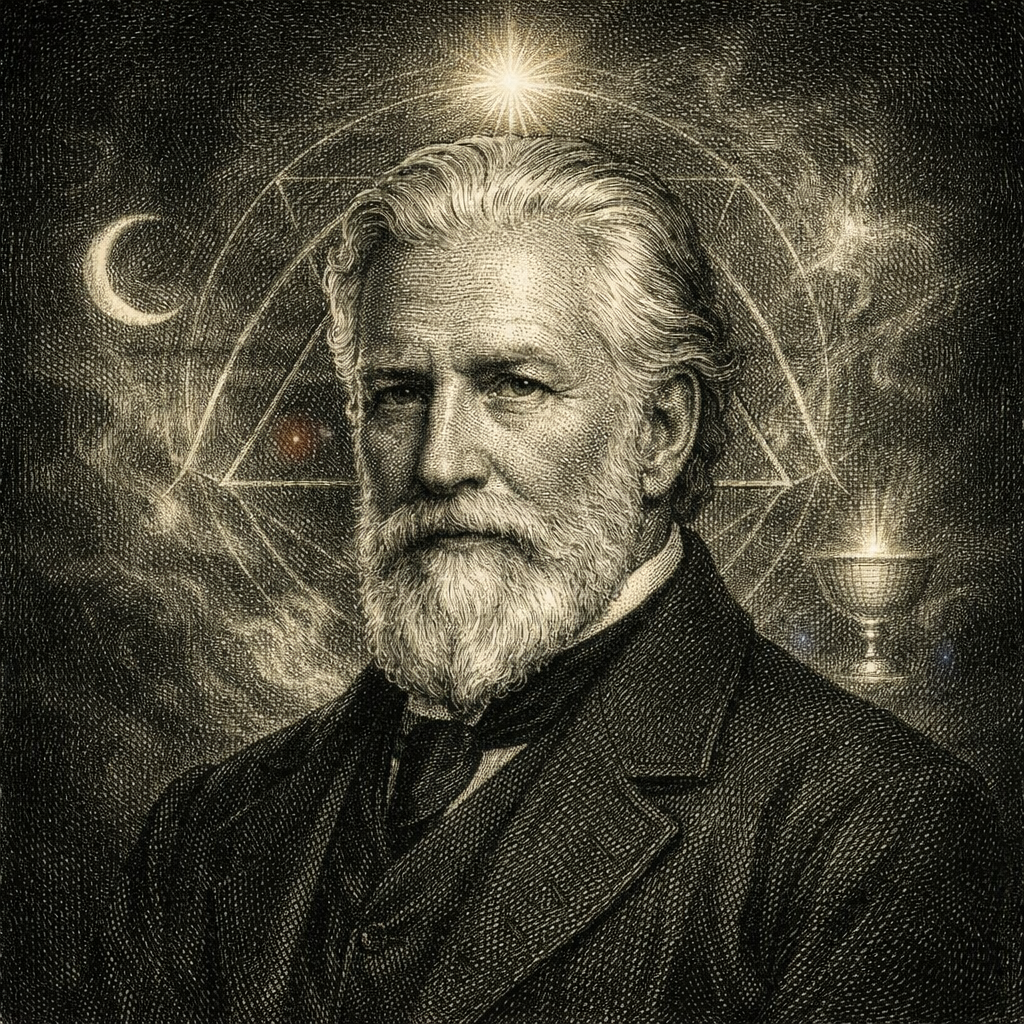
Date range: 1854–1934
Brief Biography
Charles Webster Leadbeater was an English Theosophist, clairvoyant writer, lecturer, former Anglican priest, and one of the most influential occult teachers of the early twentieth century. Born in 1854, he joined the Theosophical Society in the 1880s and became closely associated with its Adyar centre, with Annie Besant, and with the movement’s later attempts to present occultism as a form of spiritual science. Leadbeater wrote extensively on subtle bodies, the astral plane, clairvoyance, thought-forms, initiation, the Masters, and the spiritual evolution of humanity. His career was also marked by controversy, especially around his personal conduct and his role in identifying Jiddu Krishnamurti as the expected vehicle of the World Teacher. He died in Australia in 1934, leaving a legacy that remains deeply influential in Theosophy, New Age spirituality, and modern occult conceptions of the unseen worlds.
Works and Texts
- Isis Unveiled
- The Secret Doctrine
- Thought-Forms
Place in the Western Esoteric Tradition
Leadbeater occupies a major place in the Western Esoteric Tradition as one of the principal systematisers of Theosophical clairvoyant cosmology. His importance lies in the way he translated Theosophical doctrine into detailed maps of invisible planes, subtle bodies, aura colours, thought-forms, post-mortem states, and occult development. Where earlier esoteric traditions often spoke through allegory, symbol, and visionary report, Leadbeater presented the unseen world with the confidence of classification. This gave later esoteric and New Age movements a practical vocabulary for energy bodies, astral travel, spiritual evolution, clairvoyant perception, and occult hierarchy. Whether one accepts his claims is another matter entirely; his influence is not optional simply because his method makes modern eyebrows perform gymnastics.
Leadbeater’s Mystical System
Charles Webster Leadbeater’s mystical system is built around the claim that invisible realities may be directly investigated by trained clairvoyant perception. His Theosophy presents the cosmos as a hierarchy of planes, bodies, forces, colours, vibrations, and intelligences, all participating in the long spiritual evolution of humanity. The visible world is only the densest level of a larger order. Human beings are more than physical organisms. They possess subtle vehicles of consciousness through which they operate on astral, mental, and higher spiritual planes.
This model gave Leadbeater’s work its distinctive character. He treated occult knowledge as something that could be observed, mapped, and described with a quasi-scientific exactness. The astral plane, the aura, the chakras, thought-forms, devachanic states, and the processes of death and rebirth were not left as vague mysteries. They were given structures, colours, classifications, functions, and evolutionary purposes. This made Theosophy accessible to readers who wanted the invisible world presented as a coherent system rather than as a collection of scattered revelations.
The doctrine of subtle bodies is central to this system. Leadbeater describes the human being as composed of interrelated vehicles operating on different planes. The physical body belongs to the material world, while the etheric, astral, mental, and higher bodies correspond to increasingly refined levels of existence. Spiritual growth involves the purification, development, and coordination of these vehicles. The aspirant gradually becomes conscious beyond the physical senses and learns to function within subtler fields of perception.
The aura became one of Leadbeater’s most influential subjects. He presented it as a visible expression of inner life, revealing emotion, thought, moral quality, temperament, and spiritual development through colour and form. Anger, devotion, affection, fear, selfishness, and aspiration were said to appear as distinct patterns in subtle matter. This idea linked psychology, ethics, and occult anatomy. The inner life was no longer hidden inside the individual. It radiated outward into the surrounding field and could be read by trained clairvoyance.
Thought-Forms, associated with Leadbeater and Annie Besant, develops this principle further. Thoughts and emotions are described as objective forms generated in subtle matter. Their shape, colour, clarity, and movement correspond to the quality of the mental or emotional state that produced them. In this system, thinking is an act of creation. The mind impresses itself upon the unseen world, and the unseen world in turn influences human consciousness. Ethical discipline therefore becomes a matter of occult hygiene as well as moral refinement.
Leadbeater’s cosmology also depends on spiritual evolution. Humanity advances through repeated lives, shaped by karma and guided by higher intelligences. Reincarnation provides the long timescale required for the development of consciousness, while karma supplies the moral law through which experience educates the soul. Initiation marks stages of accelerated growth, in which the aspirant consciously enters the path of service and becomes increasingly aligned with the purposes of the Masters.
The Masters occupy a crucial role in Leadbeater’s thought. They are advanced beings who have passed beyond ordinary human limitation and guide the spiritual development of humanity. Leadbeater’s writings present them as real, organised, and active within a hidden hierarchy. This gave Theosophy a structure of authority that was at once spiritual, initiatory, and cosmological. The path was not only inward; it was supervised by higher intelligences within a vast evolutionary order.
Leadbeater’s account of the astral plane became especially influential. He described it as a realm of desire, emotion, imagery, elemental life, and post-mortem experience. After death, the individual passes through states corresponding to the quality of the life just lived. The astral world is therefore both a region of experience and a mirror of consciousness. This vision shaped many later occult and New Age assumptions about afterlife states, astral travel, psychic perception, and the continuity between inner condition and outer environment.
His work also helped shift esotericism toward visual and experiential immediacy. Earlier occult systems often relied on inherited symbols, ritual structures, scriptural exegesis, or philosophical speculation. Leadbeater’s authority rested on claimed observation. He wrote as if describing a landscape he had inspected. This gave his prose an unusual certainty and made his cosmology feel concrete to readers. The cost of that certainty is obvious: the whole system depends heavily on the credibility of clairvoyant testimony. The benefit, at least historically, is equally clear: he made the invisible world seem organised, inhabitable, and teachable.
Leadbeater’s influence on later movements is substantial. Anthroposophy, New Age spirituality, the Traditionalist response to modern spiritual universalism, and ritual occult currents all developed in an environment shaped partly by Theosophical ideas about planes, subtle bodies, spiritual evolution, masters, and hidden wisdom. Later writers often revised, rejected, or repackaged his claims, but the vocabulary remained. Aura reading, chakras, astral travel, thought-forms, higher planes, and evolutionary spirituality all owe part of their modern Western form to the Theosophical world Leadbeater helped codify.
Leadbeater’s mystical system may therefore be understood as clairvoyant cosmology. It offers a map of the unseen universe and a corresponding account of human development within it. The soul evolves across lives, the inner life takes visible subtle form, thought creates structure, and trained perception reveals the hidden architecture of existence. His work gave modern esotericism a detailed anatomy of invisible worlds, and that anatomy has proved remarkably durable, even when detached from the institutional Theosophy that produced it.
Antecedent Figures
- Emanuel Swedenborg
- Jacob Boehme
- Louis-Claude de Saint-Martin
- Martinez de Pasqually
- Papus (Gérard Encausse)
- Éliphas Lévi
Antecedent Traditions
- Illuminism & Christian Theosophy
- Occult Revival & Ritual Magic
- Eastern Religions
- Spiritualism
Succeeding Figures
- Arthur Edward Waite
- Julius Evola
- René Guénon
- Rudolf Steiner
- S.L. MacGregor Mathers
- William Wynn Westcott
Succeeding Traditions
- Anthroposophy
- New Age Movement
- Traditionalist School
- Hermetic Order of the Golden Dawn