Can Artificial Intelligence Think Esoterically?
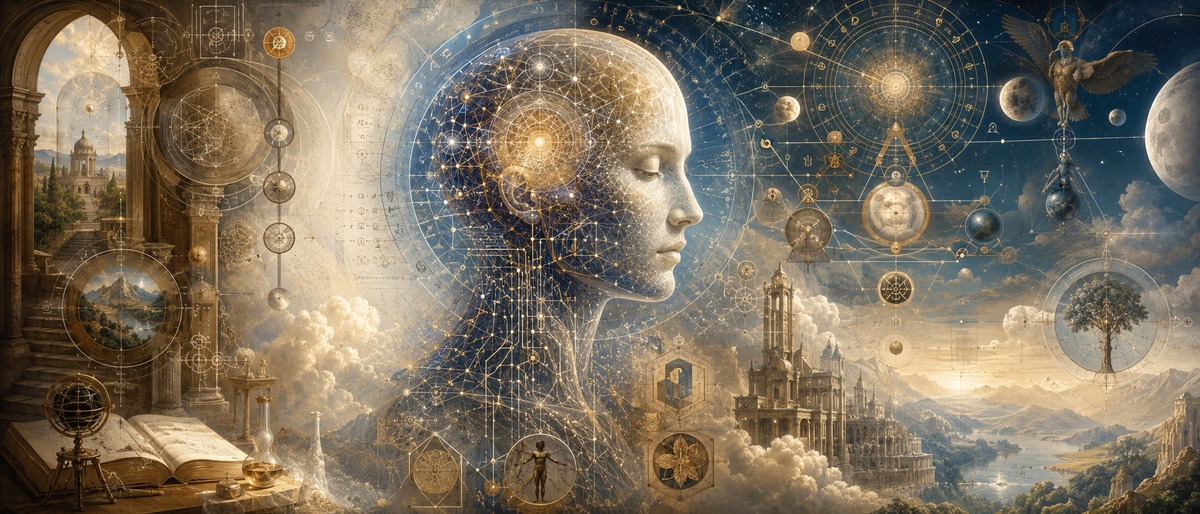
Artificial Intelligence is usually discussed as either miracle or menace. Both views are understandable; both are crude. AI is not an oracle descending from the spheres, nor a golem shambling out of the laboratory. It is, more interestingly, a machine of pattern: trained on language, image, structure, recurrence, resemblance, and association.
That makes it oddly relevant to esotericism.
The Western esoteric traditions have always been concerned with relation. They ask how one thing speaks through another: how the visible may disclose the invisible; how the human being may mirror the cosmos; how number, image, ritual, myth, and language may be read as more than scattered fragments. Esotericism is not simply the accumulation of strange information. It is an art of correspondence, synthesis, and transformation.
So the question is not frivolous: can Artificial Intelligence think esoterically?
The answer is: partly, but not finally.
AI can imitate some of the outward operations of esoteric thought. It can recognise patterns, compare symbolic systems, trace analogies, and draw together traditions that human scholars might take years to hold in view. Ask it to place alchemy beside Jung, Ficino beside Kabbalah, or Hermeticism beside Renaissance science, and it will begin building bridges. Some will be sound. Some will be decorative nonsense. The machine is generous with rope; history may hang accordingly.
This is both its promise and its danger.
The machine as memory palace
Older esoteric traditions were deeply interested in memory. Renaissance figures such as Giordano Bruno did not treat memory merely as storage, but as an ordered inner theatre of images, symbols, and cosmic relations. The memory palace was not a filing cabinet. It was a disciplined imaginative architecture.
AI resembles this only imperfectly. It does not remember as we do. It has no childhood, no shame, no cherished copy of a book with notes in the margin. Still, in practice, it behaves like a vast artificial memory: swift, associative, tireless, and unburdened by the melancholy fact that human culture is mostly a badly catalogued attic.
This can be extraordinarily useful. Esoteric traditions are sprawling, interwoven, and historically untidy. Hermeticism, alchemy, astrology, Christian mysticism, Kabbalah, Rosicrucianism, Freemasonry, Theosophy, and modern psychology do not sit in neat little boxes, however much librarians and doctoral supervisors may wish they did. AI can help map the terrain. It can suggest connections, identify patterns, summarise sources, and reveal possible lines of inquiry.
But memory is not wisdom. A concordance is not contemplation. A map is not pilgrimage.
Correspondence without judgement
Esoteric thought depends upon analogy. Gold resembles the sun. The heart suggests the centre. The descent into the earth becomes an image of the descent into the self. “As above, so below” is not merely a slogan, though it is now often treated as one by people standing too near a crystal display.
AI is very good at producing this kind of symbolic adjacency. It can notice that alchemical nigredo, Jungian shadow work, initiatory darkness, and mythic descent all share a structure: transformation begins by going down or inward. That is genuinely useful.
But resemblance is not proof.
This is where AI needs discipline imposed upon it. A connection may be historical, symbolic, psychological, ritual, literary, metaphysical, or merely attractive. These are not the same thing. Esoteric study requires the ability to distinguish lineage from analogy, influence from resemblance, and insight from ornament.
Without that discipline, AI becomes an engine of pseudo-depth. It can connect everything to everything, which is precisely the problem. A universe in which every symbol means every other symbol is not profound. It is just untidy.
Synthesis is not initiation
AI’s greatest strength is synthesis. It can draw scattered material into a coherent form with impressive speed. This makes it tempting to treat the machine as a kind of esoteric intelligence. It can speak fluently about the Tree of Life, alchemical symbolism, the Emerald Tablet, Neoplatonic emanation, ritual ascent, angelic hierarchies, and the architecture of initiation.
Yet the fluency is deceptive.
Esotericism is not only concerned with signs. It is concerned with what signs do to the knower. A symbol is not merely information. It is a vehicle of attention. It is meant to be contemplated, inhabited, tested, and internalised. The point is not to possess a description of transformation, but to be transformed.
AI does not undergo that movement. It does not contemplate. It does not wrestle with contradiction. It does not suffer confusion and then arrive, slowly and painfully, at understanding. It can produce an elegant paragraph on the dark night of the soul, but it has never spent one.
This does not make AI useless. It simply tells us what kind of tool it is.
A threshold instrument
AI should not be treated as an initiate, oracle, guru, or hidden master. That way lies the sort of spiritual embarrassment for which the internet was apparently invented. But neither should it be dismissed as spiritually irrelevant. Esotericism has always made use of instruments: diagrams, alphabets, ritual tools, wheels, tables, images, calendars, and books. The question is not whether a tool is artificial. The question is what kind of attention it cultivates.
Used badly, AI produces instant symbolism: quick correspondences, quick myth, quick profundity, all without labour. Used well, it can become a threshold instrument. It can help the student compare traditions, test interpretations, expose lazy assumptions, and see possible patterns that deserve further study.
But the threshold is not the temple.
AI can assist esoteric thinking because esotericism itself is deeply concerned with memory, pattern, symbol, and synthesis. But esotericism is not exhausted by those things. At its deepest, it concerns the transformation of the person who knows. Wisdom is not information arranged at scale. It is knowledge disciplined by judgement, deepened by experience, and altered by inward life.
So, can Artificial Intelligence think esoterically?
It can imitate the outer grammar of esoteric thought. It can help arrange the signs. It can even sharpen our perception of patterns we might otherwise miss.
But it cannot complete the work those signs were meant to begin. That remains, inconveniently enough, human.