Arthur Edward Waite
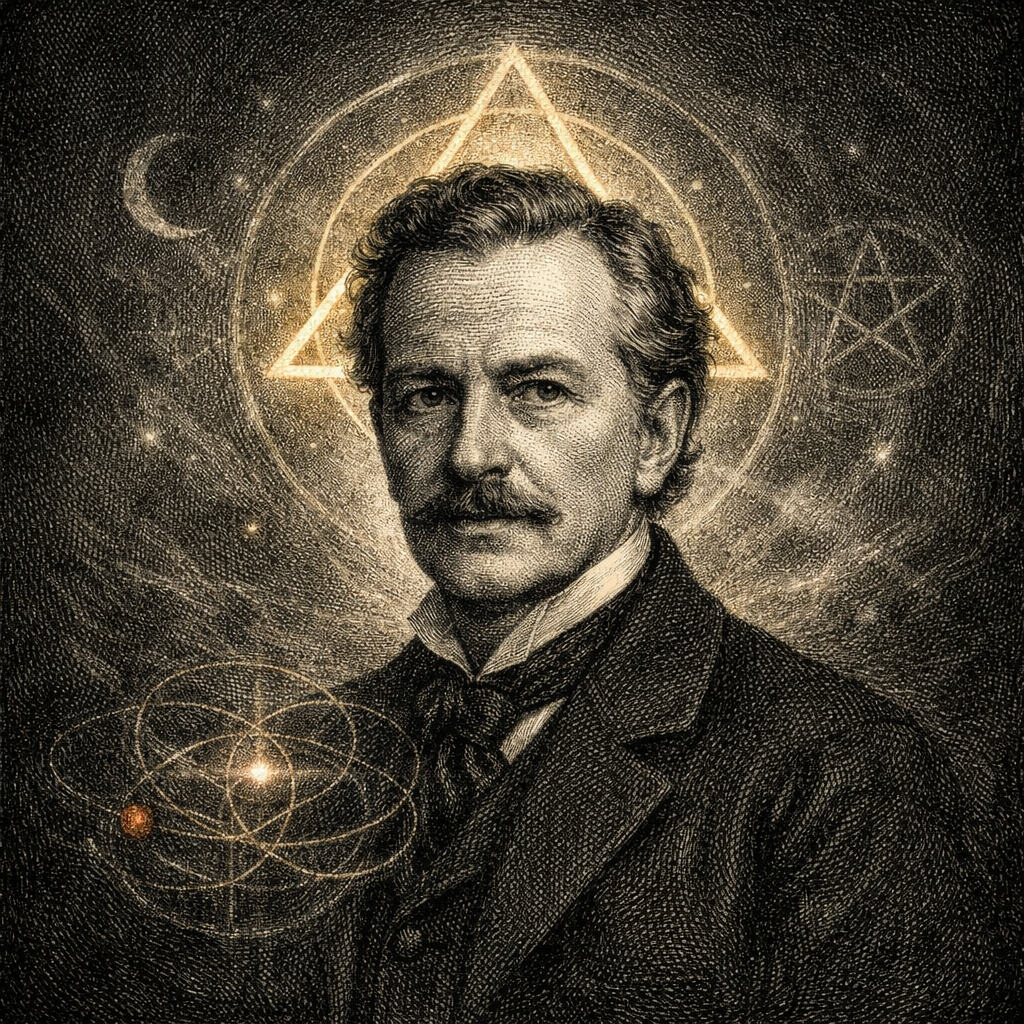
Date range: 1857–1942
Brief Biography
Arthur Edward Waite was an American-born British writer, occultist, editor, translator, and esoteric historian whose work helped shape the public understanding of modern ceremonial magic, tarot, Rosicrucianism, Kabbalah, and Christian mysticism. Born in Brooklyn in 1857 and raised chiefly in England, he became associated with the late nineteenth-century occult revival and joined the Hermetic Order of the Golden Dawn. Waite was less interested in magical sensationalism than in the inner religious and mystical meaning of esoteric symbolism. His writings and editorial labours helped transmit complex occult and mystical materials to a wider educated readership, while his later work increasingly emphasised a Christian and sacramental interpretation of the hidden tradition. He died in 1942, leaving a substantial body of writing that remains influential, contested, and occasionally exhausting in the majestic density of its prose.
Works and Texts
- The Kabbalah Unveiled
- The Cipher Manuscripts
- Collectanea Hermetica
- The Secret Doctrine in Israel
- The Golden Dawn
Place in the Western Esoteric Tradition
Waite occupies an important place in the Western Esoteric Tradition as a mediator, editor, interpreter, and re-framer of occult material inherited from Rosicrucianism, angelic magic, the occult revival, and the Theosophical milieu. His importance lies in the way he drew ceremonial, Kabbalistic, Rosicrucian, and mystical currents toward a more interior and religious understanding of initiation. Waite’s work stands at the meeting point between ritual occultism and Christian mysticism. He helped preserve and transmit esoteric materials associated with the Golden Dawn and related currents, while arguing that their deepest value lay not in magical display or occult power, but in spiritual regeneration and inward illumination. Through this interpretive emphasis, he influenced later developments in Thelema, B.O.T.A., and modern tarot-based and initiatory currents.
Waite’s Mystical System
Arthur Edward Waite’s mystical system is centred on the idea of inward initiation. Across his writings, editions, and symbolic interpretations, he treats the Western Esoteric Tradition as a veiled record of spiritual regeneration. Ritual, symbol, Kabbalah, Rosicrucian allegory, tarot, and ceremonial forms are valuable because they point toward an interior mystery: the transformation of the soul through contact with divine reality. The true work is not the acquisition of occult power, but the recovery of spiritual union.
This emphasis distinguishes Waite from many of the more flamboyant figures of the occult revival. He was deeply involved with the same bodies of material: the Golden Dawn, Rosicrucian traditions, Kabbalah, Hermetic symbolism, tarot, alchemical allegory, and the literature of secret societies. Yet he repeatedly sought to separate the spiritual meaning of these traditions from what he regarded as theatrical magic, curiosity, and lower occultism. His esotericism is sacramental and contemplative in tone. It is concerned with hidden wisdom as a path of interior sanctification.
Waite’s handling of Kabbalah illustrates this tendency. In The Secret Doctrine in Israel, he approached Kabbalah as a spiritual and mystical tradition rather than as a storehouse of magical correspondences alone. His concern was with divine manifestation, the structure of spiritual reality, and the soul’s movement toward God. Kabbalistic symbolism became part of a wider Christian esoteric vocabulary through which the relation between the human and the divine could be contemplated. This was not a neutral historical approach by modern academic standards. It was an interpretive and devotional one, shaped by Waite’s conviction that the hidden tradition contained a Christian mystical heart.
His relation to the Golden Dawn is equally significant. Waite inherited from the Golden Dawn a complex symbolic world: grades, ritual structures, elemental and planetary symbolism, tarot attributions, Kabbalistic correspondences, and initiatory drama. He valued the symbolic and initiatory dimensions of this inheritance, but he resisted interpretations that reduced the work to practical magic or occult technique. For Waite, initiation should disclose a spiritual mystery rather than merely train the operator in ritual control. This tension shaped his later attempts to reform or redirect initiatory work toward a more explicitly mystical and Christian orientation.
The tarot became one of Waite’s most enduring vehicles of esoteric interpretation. Although his name is now inseparable from the tarot deck associated with him, his deeper contribution lies in the spiritual reading of the cards. Tarot symbolism, in Waite’s hands, becomes a set of images through which the soul’s journey may be contemplated. The major arcana are not simply fortune-telling devices or occult emblems. They form a symbolic sequence concerned with fall, trial, instruction, illumination, sacrifice, judgement, and spiritual completion. The cards are visual theology disguised as a pack of pasteboard, which is precisely the sort of indignity symbols have always endured.
Waite’s editorial and historical work also shaped the reception of earlier esoteric currents. Through translations, introductions, compilations, and interpretive studies, he made Rosicrucian, Hermetic, Kabbalistic, and magical texts available to a modern readership. His work often combined scholarship, speculation, and theological interpretation. He was not simply preserving documents. He was arranging them within a larger account of the secret tradition as a Christian mystical inheritance. This made his work both influential and controversial. Later readers have often used Waite as a gateway into primary sources while resisting his interpretive conclusions.
Rosicrucianism held a special place in Waite’s imagination. He saw in Rosicrucian literature a symbolic language of spiritual fraternity, hidden wisdom, moral regeneration, and interior illumination. The Rosicrucian adept was not merely a possessor of secrets, but a figure of sanctified knowledge. This reading allowed Waite to connect Rosicrucian myth to Christian mysticism and sacramental transformation. The secret brotherhood became an emblem of the invisible church of the awakened soul.
Waite’s system is therefore deeply concerned with hierarchy of interpretation. Symbols may be read at a lower level as magical signs, historical curiosities, or fragments of occult practice. Their higher meaning lies in the drama of spiritual return. Alchemy becomes a language of inner transmutation. Kabbalah becomes a contemplation of divine emanation and restoration. Tarot becomes a symbolic pilgrimage. Ritual becomes an enacted mystery. The recurring movement is from the outer form toward the inward grace that form conceals.
This helps explain Waite’s complicated relation to later esoteric movements. Thelema, B.O.T.A., and Neo-Pagan or Wiccan currents all inherited parts of the same occult environment in which Waite worked: tarot, ritual symbolism, Golden Dawn structures, correspondences, and the idea of initiation as transformative process. Some later movements moved in directions very different from Waite’s Christian mystical emphasis. Even so, his editorial work and symbolic interpretations helped preserve and organise materials that became central to twentieth-century esotericism.
Waite’s importance lies in his insistence that Western esotericism cannot be understood only as magic, secrecy, or occult technique. For him, the hidden tradition points toward a spiritual mystery at the centre of religious life. His work attempts to recover that centre beneath the debris of fraud, fantasy, ritualism, and antiquarian confusion. He did not always succeed cleanly, and his prose can feel like a cathedral built entirely out of subordinate clauses. Yet the underlying vision is clear: the esoteric tradition is a symbolic and initiatory path toward the restoration of the soul in God.
In this sense, Waite stands as one of the great interpreters of modern esoteric inwardness. He took the materials of the occult revival and read them through a contemplative, sacramental, and Christian mystical lens. His legacy is not simply a body of texts or a famous tarot deck, but a particular way of understanding esotericism itself: as an outer veil covering an inner doctrine of spiritual transformation.
Antecedent Figures
- Annie Besant
- Charles Webster Leadbeater
- Edward Kelley
- Helena Petrovna Blavatsky
- Johann Valentin Andreae
- John Dee
- Michael Maier
- Papus (Gérard Encausse)
- Robert Fludd
- Éliphas Lévi
Antecedent Traditions
- John Dee's Angelic Magic
- Rosicrucianism
- Occult Revival & Ritual Magic
- Theosophical Society
Succeeding Figures
- Aleister Crowley
- Gerald Gardner
- Paul Foster Case
Succeeding Traditions
- Thelema
- B.O.T.A.
- Neo-Paganism/Wicca