Antoine Court de Gébelin
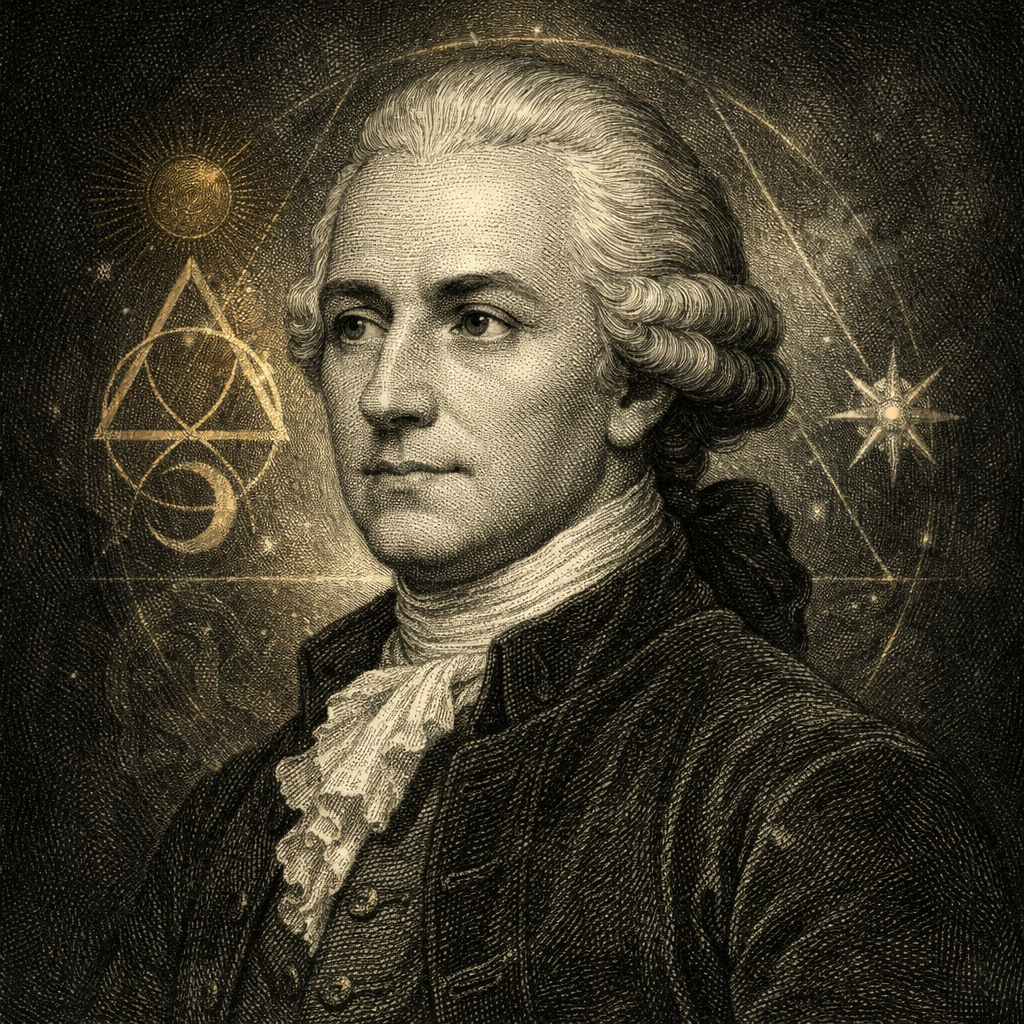
Date range: 1725–1784
Brief Biography
Antoine Court de Gébelin was a French Protestant pastor, Freemason, writer, and antiquarian whose work helped transform the tarot from a card game into an object of esoteric interpretation. Born in Nîmes in 1725, he was the son of the Huguenot pastor Antoine Court and was shaped by the intellectual and religious pressures facing French Protestantism in the eighteenth century. He became known above all for Le Monde Primitif, an ambitious multi-volume attempt to recover the traces of an original language, religion, and wisdom beneath the myths, symbols, customs, and alphabets of the ancient world. Within that project he published one of the earliest influential occult readings of the tarot, arguing that the cards preserved fragments of ancient Egyptian wisdom. He died in Paris in 1784, leaving behind a theory that was historically fragile but extraordinarily influential.
Works and Texts
- Le Monde Primitif
- Manière de se récréer avec le jeu de cartes nommées Tarots
Place in the Western Esoteric Tradition
Court de Gébelin occupies an important place in the Western Esoteric Tradition because he gave the tarot a new symbolic ancestry and helped make it available to later occult interpretation. His claim that the tarot preserved ancient Egyptian wisdom was not historically sound, but its imaginative consequences were immense. By reading the cards as remnants of a primordial symbolic language, he shifted tarot from recreation into revelation. Later occultists, especially Éliphas Lévi and Papus, would build far more elaborate systems on this foundation, linking tarot to Kabbalah, magic, initiation, and the structure of the universe. Court de Gébelin’s importance lies in this act of symbolic relocation: he made the tarot available as an esoteric text.
Court de Gébelin’s Mystical System
Court de Gébelin’s mystical system is grounded in the search for primordial unity. His great project, Le Monde Primitif, attempted to recover an original wisdom concealed within language, myth, ritual, symbolism, and ancient custom. He believed that the scattered traditions of the ancient world could be read as fragments of an earlier and more universal order of knowledge. Civilisation, in this view, had not simply progressed from ignorance to enlightenment. It had also forgotten, divided, and obscured an original inheritance.
This concern with origins places Court de Gébelin firmly within the intellectual atmosphere of the eighteenth century. Antiquarian scholarship, comparative mythology, Freemasonry, biblical history, Enlightenment speculation, and the fascination with Egypt all contributed to his thought. He sought a universal grammar of culture, a hidden continuity beneath the diversity of peoples and traditions. The ancient world was treated as a symbolic archive, and the task of interpretation was to recover the meanings buried within it.
His reading of the tarot belongs to this broader project. In the essay usually known as Manière de se récréer avec le jeu de cartes nommées Tarots, Court de Gébelin argued that the tarot was not merely a European card game. He interpreted it as a remnant of ancient Egyptian wisdom, preserved through images after its original meaning had been forgotten. The deck became, in his hands, a portable book of symbols. Its figures were read as traces of priestly knowledge, cosmology, moral teaching, and sacred allegory.
The historical claim was flawed. Modern scholarship does not support the idea that tarot originated in ancient Egypt, and the cards are more securely located in late medieval and Renaissance Europe. Yet the importance of Court de Gébelin’s interpretation lies less in its accuracy than in its consequences. He changed the imaginative status of the tarot. A set of playing cards could now be approached as a hieroglyphic text, an archive of ancient wisdom, and a symbolic key to hidden correspondences. Once this shift occurred, the later occult history of tarot became possible.
Egypt occupies a central role in this transformation. For Court de Gébelin, Egypt represented antiquity, priestly science, symbolic wisdom, and the sacred language of images. His appeal to Egypt gave the tarot an aura of immense age and authority. The Egyptian origin theory also allowed him to place the cards within the wider eighteenth-century fascination with hieroglyphs and hidden writing. Images were treated as survivals of a more ancient mode of knowledge, one in which symbol, religion, cosmology, and language had not yet been separated into modern categories.
This approach gave tarot a new function. The cards were no longer only instruments of play or fortune-telling. They became objects of contemplative and interpretive study. Each image could be read as part of a larger symbolic order. The sequence of cards suggested hidden structure; the figures invited allegorical interpretation; the deck as a whole appeared to preserve a lost wisdom in visual form. Court de Gébelin thus helped create the conditions in which tarot could become central to occult pedagogy and ritual imagination.
His theory also reflects a wider esoteric pattern: the belief that ancient symbols preserve truths forgotten by ordinary history. This pattern would become increasingly important in the occult revival. The past was not treated simply as a chronological sequence of events. It became a repository of veiled revelation. Ruins, myths, alphabets, rites, emblems, and cards could all be read as remnants of a sacred science. Court de Gébelin’s work is one of the clearest examples of this habit of interpretation.
The later development of occult tarot depended heavily on this opening. Éliphas Lévi would link tarot to the Hebrew alphabet, Kabbalah, magic, and the symbolic structure of occult philosophy. Papus would further systematise tarot within the ritual and occult currents of the nineteenth century. Their systems moved well beyond Court de Gébelin’s claims, but they inherited his decisive premise: tarot was an esoteric book, and its images concealed ancient wisdom. Without that premise, the elaborate occult tarot systems of the nineteenth century would have had a much weaker foundation.
Court de Gébelin’s importance also lies in the way he joined scholarship and speculation. His work belongs to an age before modern academic disciplines had drawn firmer boundaries between philology, mythology, antiquarianism, esotericism, and imaginative reconstruction. This can make his arguments appear extravagant, and often they are. Yet his method reveals a powerful impulse within Western esotericism: the desire to read culture as a set of broken signs pointing back to a lost unity. The scholar becomes an interpreter of fragments, and the fragment becomes a doorway into primordial truth.
His mystical system is therefore best understood as symbolic restoration. Court de Gébelin sought to recover an ancient order of meaning hidden in plain sight. In the tarot he believed he had found one such survival: a set of images whose original wisdom had outlived the civilisation that produced it. The historical premise failed, but the symbolic act endured. By treating tarot as a sacred and ancient text, he helped redirect the future of occult symbolism. The cards would never again be only cards, which is the sort of thing that happens when antiquarians get near a deck and decide Europe needs more mystery.
Antecedent Figures
- —
Antecedent Traditions
- —
Succeeding Figures
- Papus (Gérard Encausse)
- Éliphas Lévi
Succeeding Traditions
- Occult Revival & Ritual Magic