Annie Besant
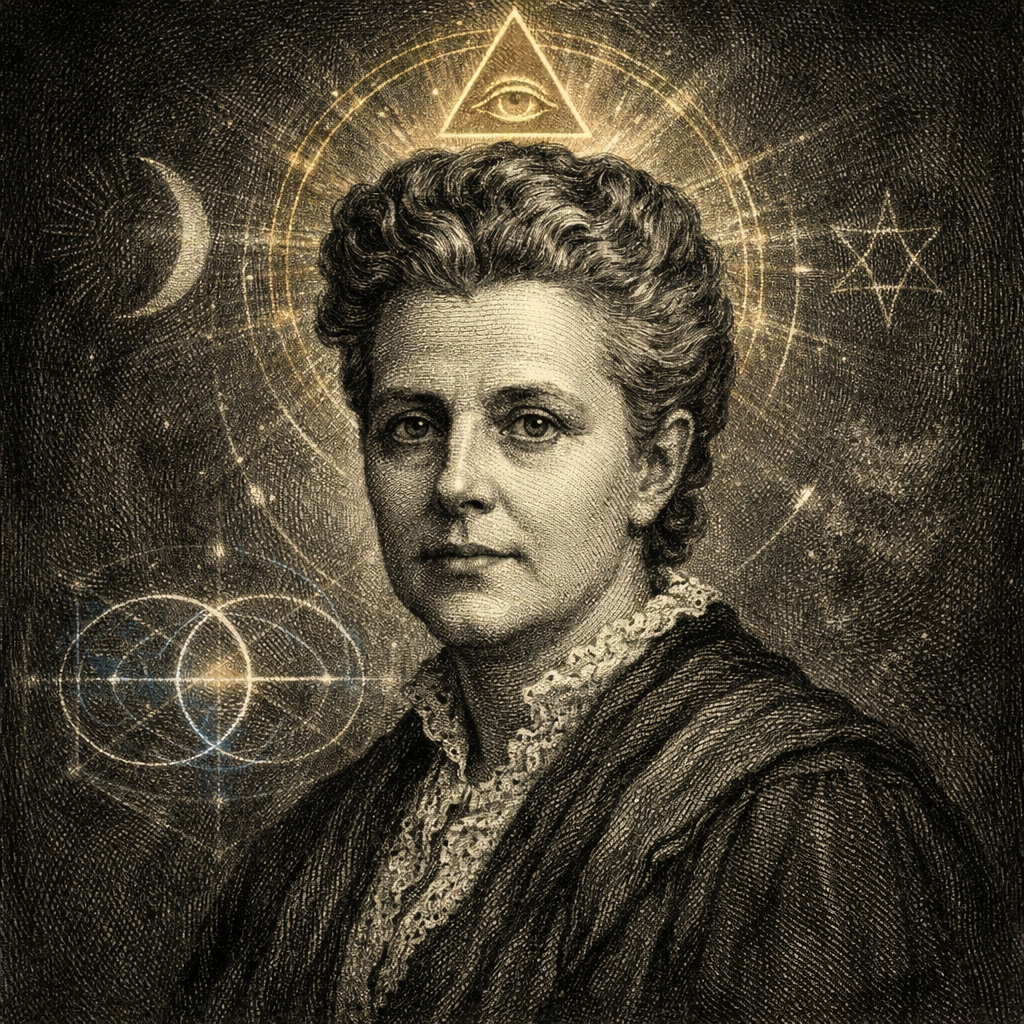
Date range: 1847–1933
Brief Biography
Annie Besant was a British writer, lecturer, social reformer, Theosophist, and political activist whose career moved through secular radicalism, socialism, women’s rights advocacy, Theosophy, Indian nationalism, and esoteric religion. Born in London in 1847, she first became widely known as a freethinker and campaigner for social reform before joining the Theosophical Society in 1889. Under the influence of Helena Petrovna Blavatsky and later in partnership with Charles Webster Leadbeater, Besant became one of the most prominent public interpreters of Theosophy. She settled for long periods in India, became President of the Theosophical Society, supported Indian self-rule, and helped make Theosophy one of the major conduits through which Western esotericism, Eastern religion, occult cosmology, and modern spiritual universalism were brought into conversation. She died in Adyar, India, in 1933.
Works and Texts
- Isis Unveiled
- The Secret Doctrine
- Thought-Forms
Place in the Western Esoteric Tradition
Besant occupies a major place in the Western Esoteric Tradition as one of the most effective transmitters and public organisers of modern Theosophy. Her importance lies in the consolidation and popularisation of a broad esoteric synthesis: Christian theosophy, occult revivalism, Spiritualism, Eastern religions, evolutionary cosmology, clairvoyant investigation, and moral-spiritual progress. She helped shift esoteric discourse from relatively enclosed initiatory, magical, and speculative circles into a global religious and educational movement. Through Theosophy, Besant influenced later currents including Anthroposophy, New Age spirituality, the Traditionalist School, and strands of ritual and Hermetic revival, even where those movements defined themselves partly by rejecting Theosophical assumptions. Such is intellectual inheritance: half transmission, half family argument conducted in public.
Besant’s Mystical System
Annie Besant’s mystical system is best understood through the Theosophical synthesis she inherited, defended, expanded, and institutionalised. Her work rests on the conviction that all religions preserve fragments of a primordial wisdom, that humanity evolves through vast cycles of spiritual development, and that the visible world is only one plane within a larger hierarchy of subtle realities. The task of the spiritual life is to awaken to that wider order and to cooperate consciously with the evolutionary movement of the soul.
Besant did not originate the central doctrines of Theosophy, but she gave them organisational force, public clarity, and missionary reach. The Theosophical world she helped construct drew on occultism, Hindu and Buddhist concepts, Western esoteric traditions, Spiritualism, Neoplatonic and Christian theosophical themes, and nineteenth-century evolutionary thought. This synthesis presented religion as a many-branched expression of a single ancient wisdom. Differences between traditions were interpreted as partial, historical, and symbolic expressions of deeper metaphysical truths.
At the centre of this system is the idea of spiritual evolution. Human beings are understood as souls passing through repeated embodiments, gradually unfolding latent capacities through experience, discipline, karma, and initiation. Reincarnation and karma provide the moral architecture of this development. Life is not a single trial followed by final judgement, but a long process of education across many lives. Each action contributes to the formation of character, and each life becomes part of a larger ascent toward wisdom, compassion, and liberation.
The universe in Besant’s Theosophy is layered. Physical reality is surrounded and interpenetrated by subtler planes: astral, mental, buddhic, and higher spiritual levels. The human being mirrors this structure through corresponding bodies or vehicles of consciousness. Spiritual development requires the purification and refinement of these vehicles, so that consciousness may function beyond the limits of the physical senses. This model gave Theosophy a detailed map of invisible reality, and it allowed Besant to explain mystical experience, psychic perception, death, dreams, ritual, and religious symbolism within a single cosmological framework.
Thought-Forms, associated with Besant and Leadbeater, illustrates one of the most distinctive features of this system. Thoughts and emotions are presented as real forms in subtle matter, shaped by colour, vibration, intention, and moral quality. The inner life is not private vaporous sentiment. It has objective effects in the unseen worlds. Anger, devotion, fear, aspiration, and love generate forms that influence both the thinker and the surrounding psychic environment. This idea turns ethics into metaphysics. To think, feel, and desire is to create.
The Theosophical use of clairvoyance also shaped Besant’s authority. She and Leadbeater claimed that trained occult perception could investigate invisible planes, past civilisations, the structure of atoms, the afterlife, and the evolution of humanity. These claims gave Theosophy an unusual blend of religious revelation and quasi-scientific confidence. It sought to speak in the language of observation, law, vibration, evolution, and experiment, while describing realities beyond ordinary verification. The result was a form of modern occultism that presented itself as both ancient wisdom and spiritual science.
Besant’s system also carried a strong ethical and social dimension. Her earlier radical commitments did not simply vanish when she entered Theosophy. They were reinterpreted within a spiritual framework. Education, social reform, women’s advancement, religious tolerance, and Indian self-rule could all be understood as expressions of human evolution. The spiritual path was not confined to private contemplation. It required service to humanity and cooperation with the larger movement of progress. In this respect, Besant gave Theosophy a public and reforming character.
Her engagement with Eastern religions was central to her influence. Theosophy helped introduce many Western audiences to Hindu and Buddhist ideas, though often through interpretive frameworks shaped by nineteenth-century esotericism rather than by traditional scholarship alone. Besant’s presentation of Hindu thought, especially in India, combined reverence, reinterpretation, and universalist synthesis. She treated India as a guardian of ancient wisdom and as a spiritual counterweight to Western materialism. This position gave Theosophy real appeal, though it also produced the familiar difficulties that arise when universalism speaks confidently on behalf of traditions more complex than its categories allow.
Besant’s influence on succeeding movements is considerable. Anthroposophy emerged from Rudolf Steiner’s break with Theosophy and retained many concerns with spiritual evolution, hidden worlds, initiation, and the interpretation of religion, while rejecting key Theosophical directions. New Age spirituality inherited from Theosophy a language of karma, reincarnation, masters, planes, subtle bodies, spiritual evolution, and the unity of religions. The Traditionalist School often opposed Theosophical modernism, yet it responded to the same modern crisis of religious plurality and the search for a primordial wisdom. Ritual and Hermetic currents also encountered Theosophy as part of the larger occult environment of the late nineteenth and early twentieth centuries.
Besant’s mystical system therefore stands as one of the great mediating structures of modern esotericism. It translated older esoteric, occult, and theosophical themes into a public religious movement with global ambitions. Its universe is ordered by evolution, karma, hierarchy, hidden planes, spiritual instruction, and the eventual awakening of humanity to its divine origin. Its characteristic mood is expansive, synthetic, reforming, and pedagogical. Besant helped make esotericism modern, international, educational, and publicly respectable enough to enter lecture halls, schools, political movements, and drawing rooms, which is perhaps the most astonishing occult feat of all.
Antecedent Figures
- Emanuel Swedenborg
- Jacob Boehme
- Louis-Claude de Saint-Martin
- Martinez de Pasqually
- Papus (Gérard Encausse)
- Éliphas Lévi
Antecedent Traditions
- Illuminism & Christian Theosophy
- Occult Revival & Ritual Magic
- Eastern Religions
- Spiritualism
Succeeding Figures
- Arthur Edward Waite
- Julius Evola
- René Guénon
- Rudolf Steiner
- S.L. MacGregor Mathers
- William Wynn Westcott
Succeeding Traditions
- Anthroposophy
- New Age Movement
- Traditionalist School
- Hermetic Order of the Golden Dawn