Andrew Michael Ramsay
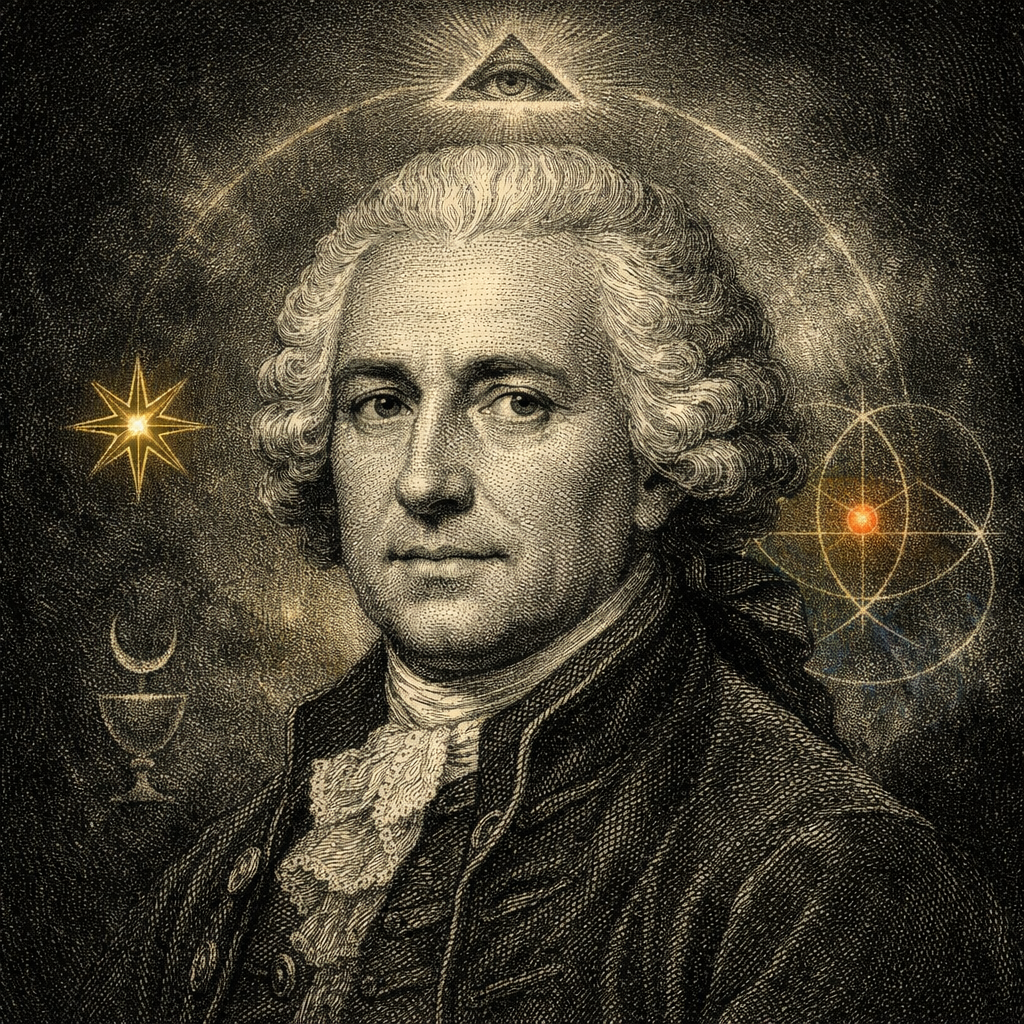
Date range: 1686–1743
Brief Biography
Andrew Michael Ramsay, often known as the Chevalier Ramsay, was a Scottish-born Jacobite, Catholic convert, tutor, writer, and Freemason whose reputation rests chiefly on his celebrated Masonic oration of 1736–1737. Born near Ayr in 1686, Ramsay moved through several religious and intellectual worlds, including Presbyterian Scotland, Anglican England, French Catholicism, and the circle of François Fénelon. His career unfolded largely in France, where he became associated with aristocratic, courtly, and devotional Catholic culture. Within the history of Freemasonry, Ramsay is important less as an organiser of lodges than as an interpreter of Masonic meaning. His oration recast Freemasonry as a chivalric, cosmopolitan, and morally reforming institution with roots in crusading knighthood rather than in the operative stonemasons’ guilds alone. He died in 1743, leaving behind an influence far larger than his relatively small body of Masonic writing might suggest.
Works and Texts
- Ramsay’s Oration
- Statutes of the CBCS
Place in the Western Esoteric Tradition
Ramsay occupies a pivotal place in the Western Esoteric Tradition because he helped redirect speculative Freemasonry toward a more chivalric, spiritual, and universalist self-understanding. His oration gave later Masonic and quasi-Masonic systems a powerful mythic language: ancient wisdom, moral knighthood, universal fraternity, sacred history, and the restoration of a lost spiritual unity. This language proved especially fertile in eighteenth-century continental Europe, where Freemasonry became intertwined with Christian theosophy, Illuminism, high-grade systems, and ritual movements seeking to recover a hidden wisdom beneath religious division and political disorder. Ramsay did not create those later systems, but his vision helped supply the imaginative bridge between early speculative Freemasonry and the more elaborate esoteric Masonries that followed.
Ramsay’s Mystical System
Andrew Michael Ramsay’s significance lies in the symbolic reorientation of Freemasonry. His Masonic vision gave the Craft a nobler and more expansive genealogy than the trade-based history of operative masonry alone could provide. In Ramsay’s Oration, Freemasonry appears as a moral, cosmopolitan, and spiritually serious institution descended from ancient and chivalric sources. The lodge becomes a place where men of different nations, ranks, and confessions may recognise one another as participants in a higher moral order.
The oration is not a technical manual of ritual magic or a systematic theological treatise. Its force lies in historical imagination. Ramsay presented Freemasonry as heir to the crusading orders, particularly to the ideal of Christian knighthood purified of mere military ambition. The crusader becomes, in his account, a figure of moral courage, discipline, honour, and sacred fraternity. This chivalric frame gave Freemasonry a new symbolic dignity. It shifted the emphasis from building craft to spiritual knighthood, from guild memory to universal moral mission.
This transformation was decisive for later developments in continental Freemasonry. The early eighteenth-century Craft already possessed ritual, symbolism, moral instruction, and claims of antiquity. Ramsay’s contribution was to deepen the historical and spiritual imagination surrounding those elements. He suggested that Freemasonry preserved traces of ancient wisdom transmitted through sacred and chivalric lineages. The effect was not antiquarian accuracy, which was rarely the governing virtue of eighteenth-century Masonic mythology. The effect was symbolic power. Freemasonry could now be imagined as a vehicle for recovering unity, virtue, and wisdom in a fractured modern world.
Ramsay’s religious background shaped this vision. His association with Fénelon and French Catholic spirituality encouraged a conception of religion grounded in inward virtue, charity, moral purification, and the restoration of spiritual order. His Freemasonry is therefore not aggressively sectarian. It does not seek to collapse all religious difference into indifference. It imagines a fraternity capable of transcending confessional conflict by appealing to deeper moral and spiritual principles. In the religious landscape of eighteenth-century Europe, that was no small claim. Europe had spent a heroic amount of energy proving that Christians could persecute one another with spectacular efficiency.
The oration’s cosmopolitanism is one of its most important features. Ramsay presents Freemasonry as a society that may unite men across national boundaries. The lodge becomes an image of an ideal republic of virtue, governed by moral law rather than factional interest. This placed Freemasonry within the broader Enlightenment concern for sociability, improvement, education, and moral reform. Yet Ramsay’s version is not merely rational or polite. It carries a sacred and chivalric charge. Brotherhood is rooted in a vision of restored spiritual order.
The chivalric element also encouraged the proliferation of high-grade Masonry. Once Freemasonry could be imagined as heir to crusading or knightly institutions, new ritual structures became possible. Grades beyond the Craft degrees could be framed as stages of spiritual knighthood, moral purification, and recovery of lost knowledge. Ramsay did not design the later systems in all their complexity, but the mythic opening created by his oration helped make them plausible. Continental Masonry would soon produce elaborate degrees involving Templar memory, Christian mysticism, secret chiefs, initiatory restoration, and sacred history arranged with the confidence of men who had never feared overcomplication.
The connection to the CBCS, or Chevaliers Bienfaisants de la Cité Sainte, belongs to this wider chivalric and Christian esoteric environment. The CBCS emerged from the Rectified Scottish Rite and drew upon themes of Christian knighthood, moral regeneration, and spiritual discipline. Its statutes reflect a later and more structured form of the chivalric Masonic imagination to which Ramsay’s oration had contributed. The movement from Ramsay’s rhetoric to such systems shows how powerful a symbolic genealogy can become. A speech about Freemasonry’s noble origins helped nourish ritual systems in which chivalry, Christianity, theosophy, and initiation were bound together.
Ramsay’s place in relation to Illuminism and Christian theosophy is therefore one of preparation and mediation. His thought does not possess the visionary metaphysics of Jacob Boehme, the spirit-world cosmology of Emanuel Swedenborg, or the initiatory theurgy associated with Martinez de Pasqually. Its importance lies in opening Masonic symbolism toward those later currents. The lodge could become more than a moral society. It could be interpreted as a vessel for spiritual restoration, a school of inner regeneration, and a fragment of a larger sacred history.
This is why Ramsay remains central to the genealogy of esoteric Freemasonry. He supplied a mythic grammar through which Masonry could be read as chivalric, universal, and spiritually restorative. The historical claims of the oration are far less important than the symbolic consequences. Ramsay gave later Masonic systems permission to imagine themselves as heirs to ancient wisdom and Christian knighthood. That imaginative permission helped shape the development of high degrees, rectified rites, Martinist currents, and the wider occult revival that drew upon Masonic forms.
Ramsay’s mystical system, if the phrase is used broadly, is a system of sacred historical interpretation. He transformed Freemasonry by giving it a spiritually charged past and a universal moral vocation. His lodge is an image of reconciled humanity; his Mason is a knight of virtue; his history is a symbolic chain linking ancient wisdom, Christian chivalry, and modern fraternity. Through that vision, Ramsay helped move Freemasonry from moral architecture toward esoteric restoration.
Antecedent Figures
- Elias Ashmole
- James Anderson
- William Preston
Antecedent Traditions
- Speculative Freemasonry
Succeeding Figures
- Emanuel Swedenborg
- Jacob Boehme
- Louis-Claude de Saint-Martin
- Martinez de Pasqually
- Papus (Gérard Encausse)
- Éliphas Lévi
Succeeding Traditions
- Illuminism & Christian Theosophy
- Occult Revival & Ritual Magic