Aleister Crowley
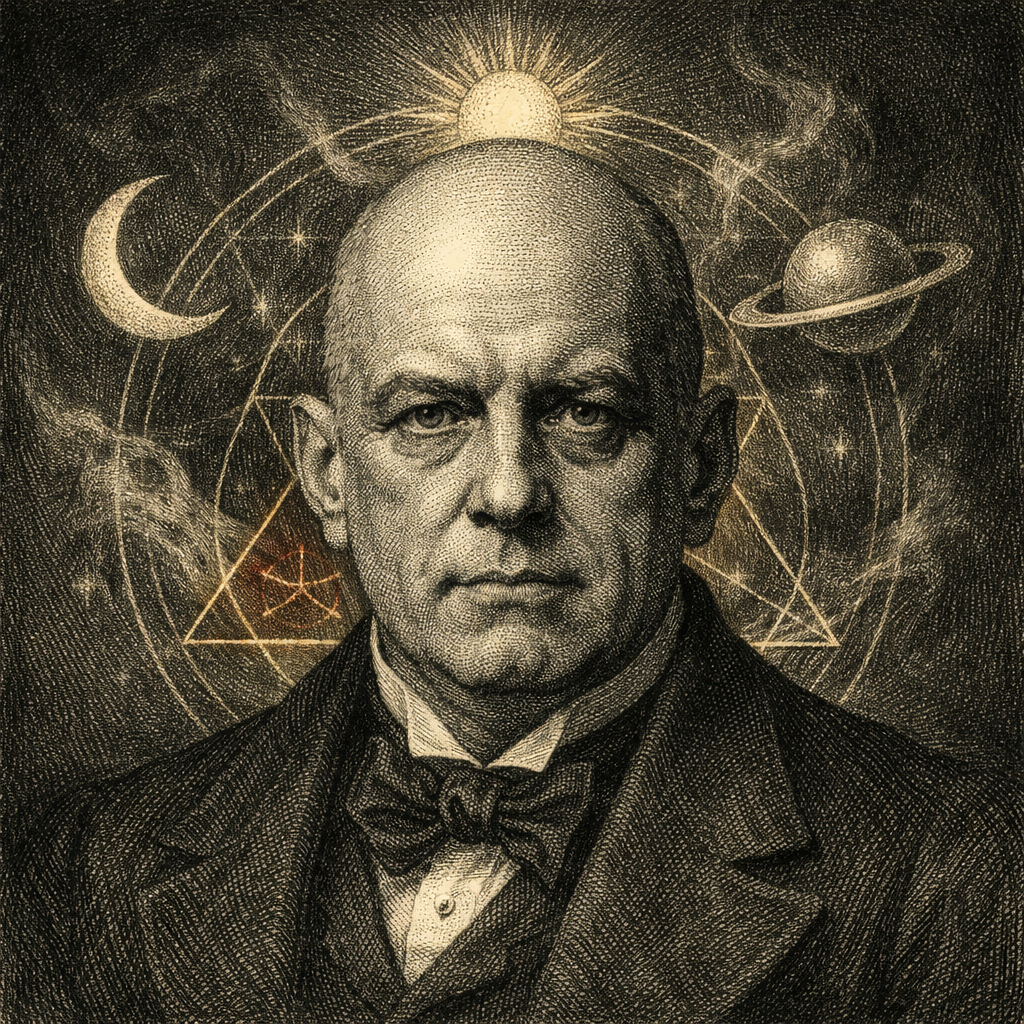
Date range: 1875–1947
Brief Biography
Aleister Crowley was an English occultist, ceremonial magician, poet, mountaineer, and religious innovator whose name became inseparable from the modern occult revival. Born Edward Alexander Crowley in 1875, he entered the Hermetic Order of the Golden Dawn in the late 1890s and absorbed its complex synthesis of ritual magic, Kabbalah, Hermetic symbolism, tarot, astrology, and initiatory hierarchy. After breaking with the Golden Dawn milieu, he developed his own religious and magical system, Thelema, centred on the revelation of The Book of the Law in 1904. Crowley spent much of his life travelling, writing, teaching, experimenting with ritual practice, and cultivating a public reputation that alternated between deliberate provocation and genuine scandal. He died in 1947, leaving behind one of the most influential and controversial bodies of work in modern Western esotericism.
Works and Texts
- The Book of the Law
- Magick in Theory and Practice
- 777
- The Vision and the Voice
Place in the Western Esoteric Tradition
Crowley occupies a central place in the modern Western Esoteric Tradition as a systematiser, reformer, and radical interpreter of ritual magic. Drawing heavily on the Golden Dawn, the occult revival, Lévi’s magical theory, tarot symbolism, Kabbalah, yoga, and ceremonial practice, he recast inherited esoteric material within the religious framework of Thelema. His work gave modern occultism a new language of will, initiation, magical discipline, and spiritual sovereignty. Crowley’s influence is difficult to avoid in twentieth-century ritual magic, even where later practitioners reject his personality, ethics, or conclusions with understandable enthusiasm. His writings helped move ceremonial magic from Victorian secrecy into a more explicit, published, and self-consciously modern form.
Crowley’s Mystical System
Aleister Crowley’s mystical system is organised around the concept of will. In Thelema, will is not ordinary preference, appetite, or personal whim. It refers to the deepest law of an individual life, the proper course of being when the self is aligned with its own spiritual nature. The famous formula “Do what thou wilt” has often been mistaken for libertinism, partly because Crowley’s public persona encouraged that misunderstanding with the subtlety of a brick through a chapel window. Within the system itself, however, will is a discipline. The task of the initiate is to discover, purify, and enact the true will.
The foundation of this system is The Book of the Law, received by Crowley in Cairo in 1904 and treated by him as the central scripture of Thelema. The text announces a new religious aeon, associated with Horus, and presents a symbolic universe in which divine authority is no longer primarily mediated through obedience to external law. Its central concern is the awakening of the individual to a deeper cosmic identity. Crowley interpreted this revelation through the combined resources of ceremonial magic, Kabbalah, yoga, astrology, tarot, Egyptian symbolism, and the initiatory structures inherited from the Golden Dawn.
Crowley’s use of the term “magick” is central to his thought. By adding the final letter, he distinguished his practice from stage conjuring and framed magic as the art and science of causing change in conformity with will. This definition placed magical practice within a disciplined programme of transformation. Ritual, invocation, meditation, divination, symbolic correspondence, and moral ordeal were all methods through which the magician sought to bring the conscious self into alignment with the true will. Magic was therefore neither mere spectacle nor simple petition to external powers. It was a structured engagement with consciousness, symbol, and reality.
The Golden Dawn provided much of Crowley’s technical inheritance. Its grades, ritual forms, Kabbalistic correspondences, elemental symbolism, tarot attributions, and ceremonial methods shaped the early architecture of his practice. Crowley retained much of this material, while reorganising it around Thelemic doctrine. 777 is especially important in this respect. It presents tables of correspondences linking Hebrew letters, divine names, planets, zodiacal signs, tarot trumps, deities, colours, perfumes, magical weapons, and other symbolic categories. Such tables allowed the magician to construct rituals in which different symbolic orders reinforced one another. The universe becomes legible through patterned analogy.
Crowley’s system also drew deeply on yoga and mystical discipline. He treated meditation, concentration, breath control, and the stilling of thought as essential parts of magical training. This reflects one of the more serious dimensions of his work. Ceremonial magic, in Crowley’s hands, is not simply ritual theatre. It requires disciplined control of attention, body, imagination, and desire. The magician must become capable of sustained concentration and internal equilibrium. Without such training, ritual becomes performance without transformation.
One of Crowley’s major spiritual goals was the Knowledge and Conversation of the Holy Guardian Angel. This idea, inherited and reworked from earlier magical traditions, became a central threshold in his initiatory system. The Holy Guardian Angel represents the deepest divine counterpart of the individual, the source through which the true will is known and the fragmented personality is brought into higher order. The encounter is both mystical and initiatory. It marks the transition from occult practice as technique to the deeper reorientation of the self.
The Vision and the Voice records Crowley’s visionary exploration of the Enochian Aethyrs, drawing on material inherited through the Golden Dawn from the Elizabethan magical work of John Dee and Edward Kelley. The text presents a sequence of visions that combine apocalyptic imagery, angelic revelation, symbolic ordeal, and the dissolution of ordinary identity. Its importance lies in the way it dramatizes Crowley’s understanding of initiation as passage through successive veils of consciousness. The aspirant is stripped of fixed identity, confronted by symbolic powers, and drawn toward an increasingly impersonal apprehension of the divine.
Crowley’s system is difficult to separate from his deliberate antinomianism. He repeatedly positioned himself against conventional morality, religious respectability, and bourgeois restraint. This was partly strategy, partly conviction, and partly self-destruction elevated into metaphysics. Within his esoteric thought, antinomianism functions as a test of inherited limits. The initiate must distinguish between genuine spiritual law and the social conditioning that masquerades as conscience. Yet this aspect of Crowley’s legacy is also the most dangerous. The rhetoric of liberation can become indulgence, manipulation, or grandiosity when not governed by discipline and ethical clarity.
His place in the Western Esoteric Tradition therefore remains double-edged. Crowley clarified and modernised large parts of ceremonial magic, gave Thelema a distinctive religious vocabulary, and preserved extensive technical material from the Golden Dawn and the wider occult revival. He also made modern occultism inseparable from questions of authority, transgression, charisma, and self-mythologising. His work cannot be reduced to scandal, though scandal became part of its transmission. Nor can it be treated as a neutral technical system without recognising the volatility of the man and the movement he created.
Crowley’s enduring significance lies in the force with which he joined ritual magic, mystical attainment, symbolic correspondence, and individual spiritual law. He made the magician into an agent of disciplined transformation, seeking alignment with will through practices that engaged the whole field of body, mind, symbol, and cosmos. In doing so, he became one of the decisive figures of modern esotericism: a transmitter of older currents, a creator of new religious forms, and a warning that spiritual intensity without proportion can become its own very elaborate trap.
Antecedent Figures
- Arthur Edward Waite
- Papus (Gérard Encausse)
- S.L. MacGregor Mathers
- William Wynn Westcott
- Éliphas Lévi
Antecedent Traditions
- Occult Revival & Ritual Magic
- Hermetic Order of the Golden Dawn
Succeeding Figures
- —
Succeeding Traditions
- —