Albertus Magnus
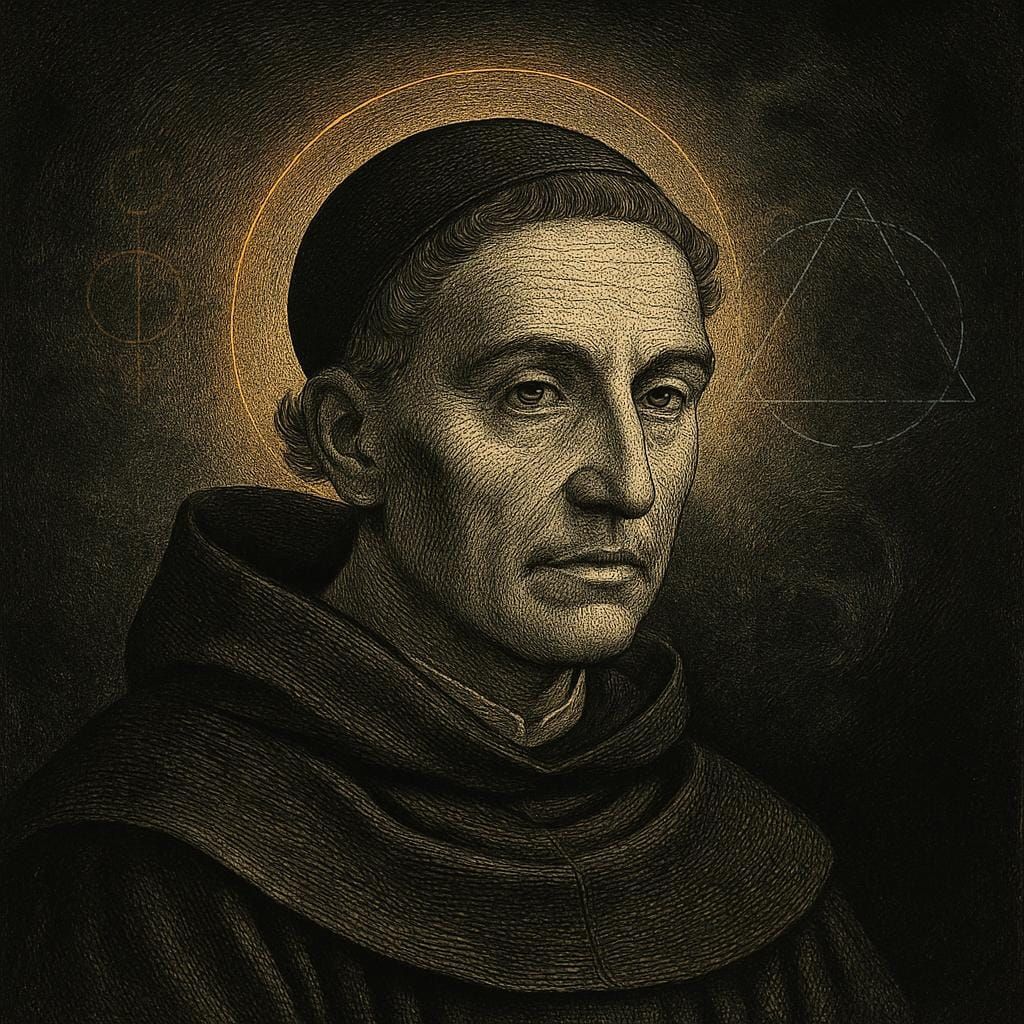
Date range: c. 1200 – 1280
Brief Biography
Albertus Magnus, also known as Albert the Great, was a German Dominican friar, theologian, philosopher, and natural philosopher whose work helped shape the intellectual culture of the medieval university. Born around 1200 and active principally in the Dominican order, he taught in major centres of learning and became one of the most important Latin interpreters of Aristotle. His intellectual range was unusually broad, extending across theology, metaphysics, logic, ethics, natural philosophy, mineralogy, botany, zoology, astronomy, astrology, and questions concerning the legitimate boundaries of learned occult knowledge. His student Thomas Aquinas would later eclipse him in scholastic theology, rather unfairly, as posterity often rewards the neat system-builder over the vast and awkward genius. Albert died in Cologne in 1280 and was later canonised and recognised as a Doctor of the Church.
Works and Texts
- Speculum Astronomiae
- Summa Theologica
Place in the Western Esoteric Tradition
Albertus Magnus occupies an important position in the Western Esoteric Tradition because he stands at the threshold between medieval scholastic natural philosophy and later Renaissance occult philosophy. His significance lies less in direct initiation into a hidden current than in the intellectual framework he helped provide for later esoteric thinkers. Albert’s writings treated nature as an ordered field of causes, powers, forms, influences, and correspondences. This made it possible to discuss celestial influence, natural marvels, stones, plants, animals, and hidden properties without immediately collapsing such inquiry into superstition or demonic magic. Later Renaissance figures working in Christian Kabbalah, Hermetic magic, and occult philosophy inherited this problem: how to distinguish lawful natural knowledge from illicit magical practice. Albert’s authority gave that question a scholastic ancestry.
Albertus Magnus’s Mystical System
Albertus Magnus’s importance for the Western Esoteric Tradition lies in his treatment of nature as a meaningful and intelligible order. His writings present the created world as a field of forms, qualities, powers, influences, and hidden operations. Nature is not reduced to inert matter. It is a structured order whose internal principles can be studied, interpreted, and placed within the broader framework of divine providence.
This gives Albert a distinctive place in the genealogy of Western esotericism. Many later esoteric traditions depend on the conviction that the visible world contains concealed structures of meaning and power. Stones, plants, animals, stars, bodies, and words participate in wider chains of causation and analogy. Albert’s natural philosophy helped provide a Christian scholastic vocabulary for such claims. He wrote as a Dominican scholar working to integrate Aristotelian and Arabic learning into Christian theology, but the resulting framework also gave later thinkers a way to speak about hidden properties and celestial influence with intellectual seriousness.
The Speculum Astronomiae, traditionally associated with Albert, is especially important in this context. Its central concern is the status of astrology and astral learning within Christian intellectual life. The text attempts to distinguish legitimate astronomical and astrological inquiry from forms of magical practice judged illicit or demonic. This distinction became a major issue for later thinkers. The heavens could be studied as part of the created order. Celestial bodies could exert influence through natural causes. The invocation of spirits, coercive rites, and practices that placed the human will in submission to occult powers belonged to a different and more dangerous category.
Albert’s broader intellectual project strengthened this boundary-making exercise. His commentaries on Aristotle and his natural-philosophical writings sought to understand the causes operating within the material world. He gave serious attention to minerals, animals, plants, generation, corruption, celestial influence, and the properties of natural things. For later esoteric thinkers, this mattered enormously. A world governed by hidden qualities and formal causes could support theories of sympathy, correspondence, astral influence, and natural magic, provided these were framed as operations within creation rather than violations of it.
The tension in Albert’s legacy lies in the fact that his work both limits and enables later esoteric speculation. His theological commitments restrict magic: the created world remains subordinate to God, and practices involving demons or unlawful control over spiritual powers fall outside legitimate inquiry. His natural philosophy nevertheless leaves room for a richly ordered cosmos, structured by intelligible causes and subtle influences. This combination allowed later Renaissance writers to present some forms of magic as learned, natural, and philosophically respectable.
This is why Albert becomes important to Renaissance Christian Kabbalah and Hermetic magic even when he is not their central doctrinal source. Ficino, Pico, Reuchlin, Agrippa, and Bruno inherited a world in which ancient theology, Kabbalah, Hermeticism, astrology, Platonism, and scholastic natural philosophy could be drawn into new syntheses. Albert’s authority helped stabilise one part of that inheritance. He showed that the study of nature’s hidden properties could be pursued within a Christian intellectual framework, provided it was carefully distinguished from forbidden magic.
His significance is also methodological. Albert represents the ambition to gather, classify, test, and interpret the whole field of available knowledge. His writings treat the natural world as worthy of sustained attention, not as a mere backdrop to theology. That habit of learned curiosity, disciplined by theological caution, became one of the preconditions for later occult philosophy. Renaissance esotericism often appears more flamboyant than medieval scholasticism, with its divine names, planetary hymns, talismans, ancient wisdom traditions, and heroic claims to universal knowledge. Beneath that more dramatic surface lies an inherited question: how can hidden powers in nature be known, and how can they be used without violating the order from which they arise?
Albert’s system therefore matters less as a body of mystical doctrine than as an intellectual architecture. He helped make the study of natural influence thinkable. He gave later writers a model for treating the world as symbolically and causally dense. He also preserved the moral and theological anxiety that would continue to haunt learned magic throughout the Renaissance. The esoteric imagination needed both elements: the permission to search for hidden powers and the warning that hidden powers must be approached within an ordered moral universe.
In this respect, Albertus Magnus stands as a crucial medieval predecessor to Renaissance esotericism. His world is ordered, layered, and alive with intelligible causes. Nature speaks through forms, qualities, and influences. The task of the learned mind is to discern these operations without confusing creation with God, natural influence with demonic intervention, or curiosity with wisdom. Later esoteric thinkers would expand this inheritance in more daring directions, but Albert helped provide the scholastic ground on which much of that expansion could stand.
Antecedent Figures
- —
Antecedent Traditions
- —
Succeeding Figures
- Giordano Bruno
- Giovanni Pico della Mirandola
- Heinrich Cornelius Agrippa
- Johannes Reuchlin
- Marsilio Ficino
Succeeding Traditions
- Renaissance Christian Kabbalah & Hermetic Magic