Abraham Abulafia
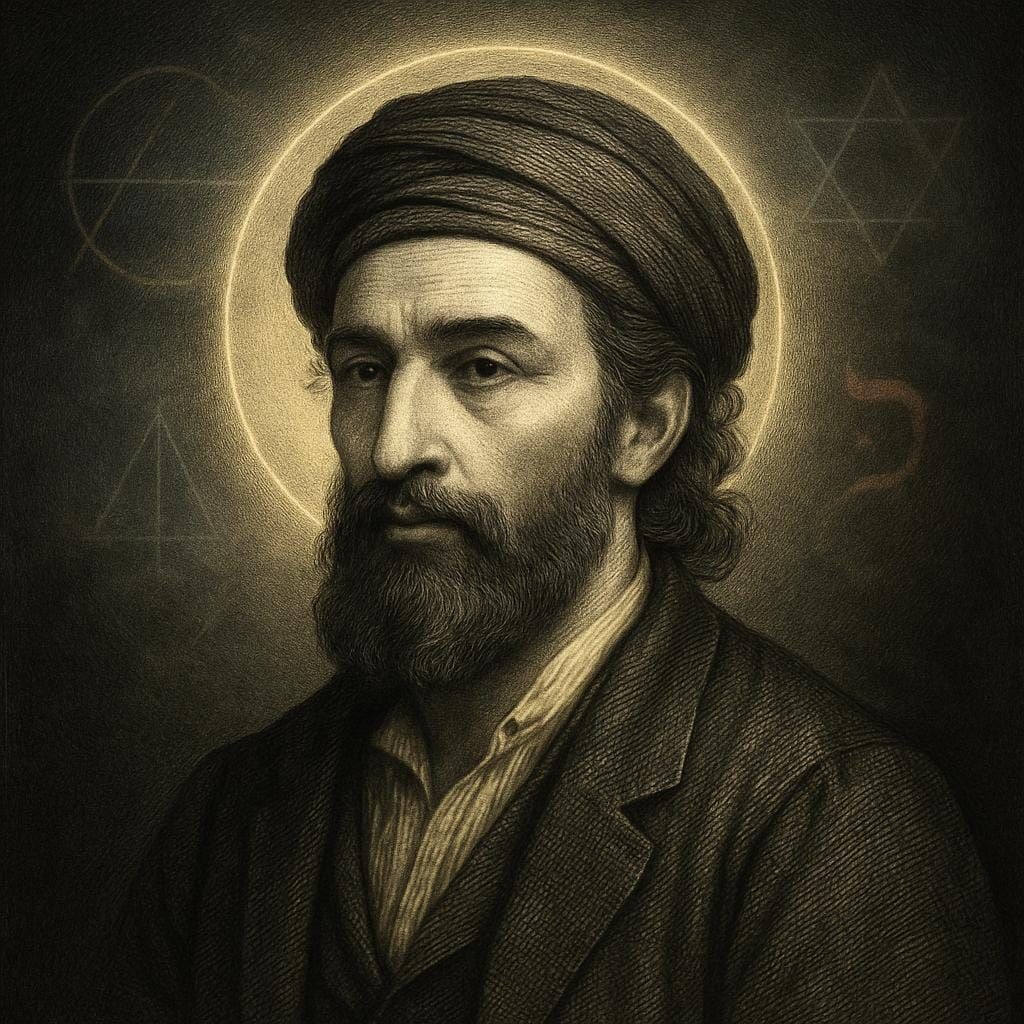
Date range: c. 1240 – after 1291
Brief Biography
Abraham Abulafia was a thirteenth-century Spanish Jewish mystic and kabbalist, born in Zaragoza around 1240 and active across the Mediterranean world, particularly in Spain and Italy. Trained in biblical, rabbinic, philosophical, and linguistic learning, he developed a distinctive form of Kabbalah centred on ecstatic and prophetic experience rather than on the more familiar theosophical contemplation of the sefirot. His method used Hebrew letters, divine names, breath, vocalisation, bodily discipline, and concentrated imagination as instruments of spiritual transformation. Abulafia attracted students and followers, but also strong opposition from rabbinic authorities, especially because of his messianic claims and the boldness of his prophetic techniques. His final years remain uncertain, and he disappears from the historical record after 1291.
Works and Texts
- The Zohar
- Life of the Future World
Place in the Western Esoteric Tradition
Abulafia occupies an important place in the Western Esoteric Tradition because his work presents one of the most technically developed forms of sacred-language mysticism in the medieval world. His Kabbalah treats letters, names, breath, voice, and imagination not simply as symbols of hidden realities, but as practical instruments through which consciousness may be disciplined and transformed. In this respect, his system stands at the meeting point of scriptural exegesis, contemplative practice, mystical psychology, and esoteric linguistics. His later reception also made him significant beyond the Jewish mystical tradition itself, since elements of Abulafian Kabbalah contributed to the Renaissance Christian Kabbalistic and Hermetic synthesis associated with figures such as Pico della Mirandola, Reuchlin, Agrippa, Ficino, and Bruno.
Abulafia’s Mystical System
Abraham Abulafia’s mystical system is built around a disciplined encounter with sacred language. The Hebrew alphabet, the divine names, breath, voice, and imagination are treated as instruments through which the mind may be refined and brought into contact with prophetic knowledge. His Kabbalah is therefore practical as well as speculative. It proposes a method by which the practitioner may move from ordinary cognition toward a heightened state of intellectual and spiritual perception.
Abulafia belongs to the wider world of medieval Kabbalah, yet his emphasis is distinctive. Much thirteenth-century Kabbalah developed around the sefirot, the divine emanations through which the hidden life of God was contemplated and symbolically described. Abulafia’s attention falls more strongly on the human faculties that make revelation possible. The central concern is the transformation of intellect, imagination, speech, and breath. His writings describe a path in which the practitioner uses sacred language to reshape consciousness and prepare for prophetic experience.
The techniques associated with Abulafia are exacting. They include the permutation of Hebrew letters, the recitation and vocalisation of divine names, controlled breathing, bodily posture, rhythmic movement, and intense meditative concentration. These practices are not ancillary exercises attached to a body of doctrine. They form the heart of the system. The letters are combined and recombined until ordinary patterns of thought begin to loosen. Breath and voice bring the body into the discipline. Imagination gives form to the process. Concentration gathers the mind into a condition of unusual intensity.
The intellectual background of this system is important. Abulafia was shaped by medieval Jewish philosophy, especially by Maimonides’ account of prophecy. Maimonides had explained prophecy through the perfection of the rational and imaginative faculties. Abulafia transformed this philosophical account into a practical mystical programme. Prophecy became something for which the soul could be trained. The contemplative use of letters and names served as a means of preparing the intellect to receive divine influx.
This gives Abulafia’s Kabbalah a highly psychological character. The work of the mystic takes place within the structure of thought, speech, perception, and imagination. The divine name is approached as a concentrated form of sacred intelligibility. The alphabet becomes a map of creation and a tool for inward reordering. The practitioner does not simply interpret sacred language from a distance. He enters into its rhythms, sounds, numerical patterns, and visual forms until language itself becomes the medium of ascent.
The visionary aspect of Abulafia’s practice follows from this discipline. His writings describe states in which the practitioner may encounter a figure or presence associated with revelation. This encounter is often understood as angelic, prophetic, or intellective. Its significance lies in the transformation of consciousness that makes such an encounter possible. Revelation appears through a purified and intensified faculty of perception. The visionary form is linked to the awakening of the intellect and the reconstitution of the self around divine knowledge.
Abulafia’s messianic claims gave his system a wider historical charge. He understood the restoration of prophecy as part of a redemptive process. The disciplined use of sacred language was connected with the purification of understanding, the overcoming of spiritual confusion, and the recovery of a lost intimacy between human intellect and divine truth. His attempted mission to Pope Nicholas III in 1280 belongs to this broader messianic self-understanding. The prophetic task had inward, intellectual, and historical dimensions.
His place in the Western Esoteric Tradition rests on this union of method, language, and transformation. Abulafia gives one of the clearest medieval accounts of sacred language as an operative discipline. Letters and names are treated as more than signs to be decoded. They become vehicles of concentration, purification, and ascent. This places him within a long esoteric concern with the hidden powers of word, number, sound, and symbol.
The later Christian reception of Kabbalah brought Abulafian ideas into a larger Renaissance setting. Christian Kabbalists and Hermetic philosophers were drawn to the possibility that divine wisdom had been encoded in sacred language and could be recovered through learned, contemplative, and sometimes magical practice. Abulafia’s Jewish mystical system retained its own integrity, yet some of its techniques and assumptions helped shape the Renaissance fascination with divine names, letter mysticism, and the union of language with spiritual power.
Abulafia’s importance lies in the precision with which he joins contemplation to technique. His writings present spiritual ascent as a disciplined reconfiguration of the human faculties through sacred form. The alphabet is a contemplative instrument, the divine name a path of concentration, and prophecy the perfected condition of the awakened intellect. In his work, language becomes an arena in which the soul is trained, tested, and transformed.
Antecedent Figures
- Hermes Trismegistus
Antecedent Traditions
- Late Antique Hermeticism & Gnosticism
Succeeding Figures
- Giordano Bruno
- Giovanni Pico della Mirandola
- Heinrich Cornelius Agrippa
- Johannes Reuchlin
- Marsilio Ficino
Succeeding Traditions
- Renaissance Christian Kabbalah & Hermetic Magic